

Halogeton
Halogeton glomeratus
Class B
Llimited to portions of the state. In areas with severe infestations, management should be designed to contain the infestation and stop any further spread.
Local Ecosystems
This plant is detrimental to native ecosystems, negatively impacting the quality of forage for wildlife and reducing biodiversity in plant communities.
Livestock Hazard
This plant presents a threat to the health and/or quality of livestock.
Agricultural Threat
This plant threatens our state’s food security and economy by reducing agriculture yields and/or degrading soil resources.
QUICK FACTS
- Halogeton is highly toxic to livestock, causing oxalate poisoning, kidney failure, and musculoskeletal issues when eaten in large amounts. It is most poisonous to sheep, but it can affect any livestock that grazes on it.
- Native to Eurasia, it is highly adaptable to many soil conditions, but it prefers drier, salty soils in bare areas. It cannot compete in areas with healthy plant coverage; instead, it invades abandoned and disturbed areas, gradually making the soils too salty for other plants to regrow.
- Halogeton’s initial spread began in 1934 and quickly took over several abandoned areas. After killing several herds of sheep, Congress passed the Halogeton Glomeratus Control Act to research its effects, spread, and prevention.
1. Overview
A highly toxic plant known as the “stock killing weed”.
Halogeton is highly toxic to livestock, particularly sheep, when consumed in large quantities. Native to Eurasia, it easily establishes itself in bare, semi-arid shrublands of the Western U.S, including New Mexico. It does not compete with healthy established vegetation, so the best way to prevent Halogeton is to maintain a healthy cover of desired forage.
History of Russian Olive
Halogeton was accidentally introduced into the U.S. in the 1930s, with the first reported collection in 1934 in Nevada. It took advantage of the widespread abandonment of land in the 1930s and 1940s to quickly spread through the West. While it does not compete with established vegetation, its ability to spread its seed by wind, water, animals, and human activity makes it quickly invade disturbed areas. [3,4,7,8]
Its reputation began in the 1940s and 1950s, when it started causing mass deaths of sheep. There were numerous instances where entire sheep herds perished overnight. It quickly gained national attention, which urged Congress to pass the Halogeton Glomeratus Control Act in 1952 to study the control and effects of halogeton. [10]
2. ID Guide
What does it look like?
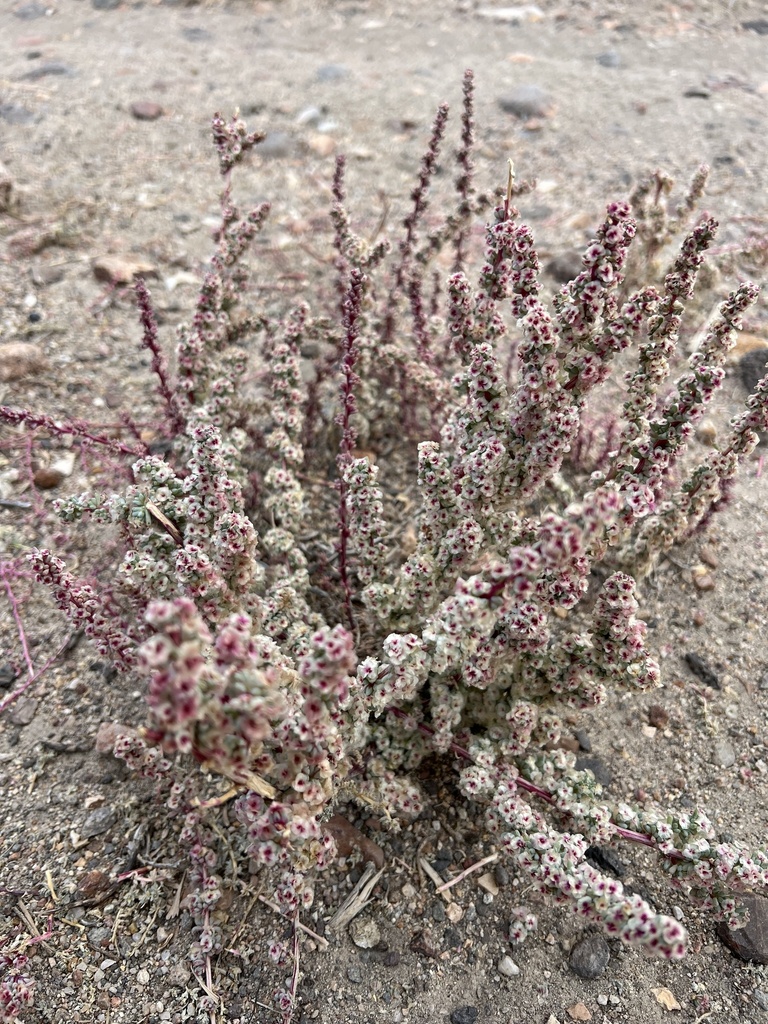
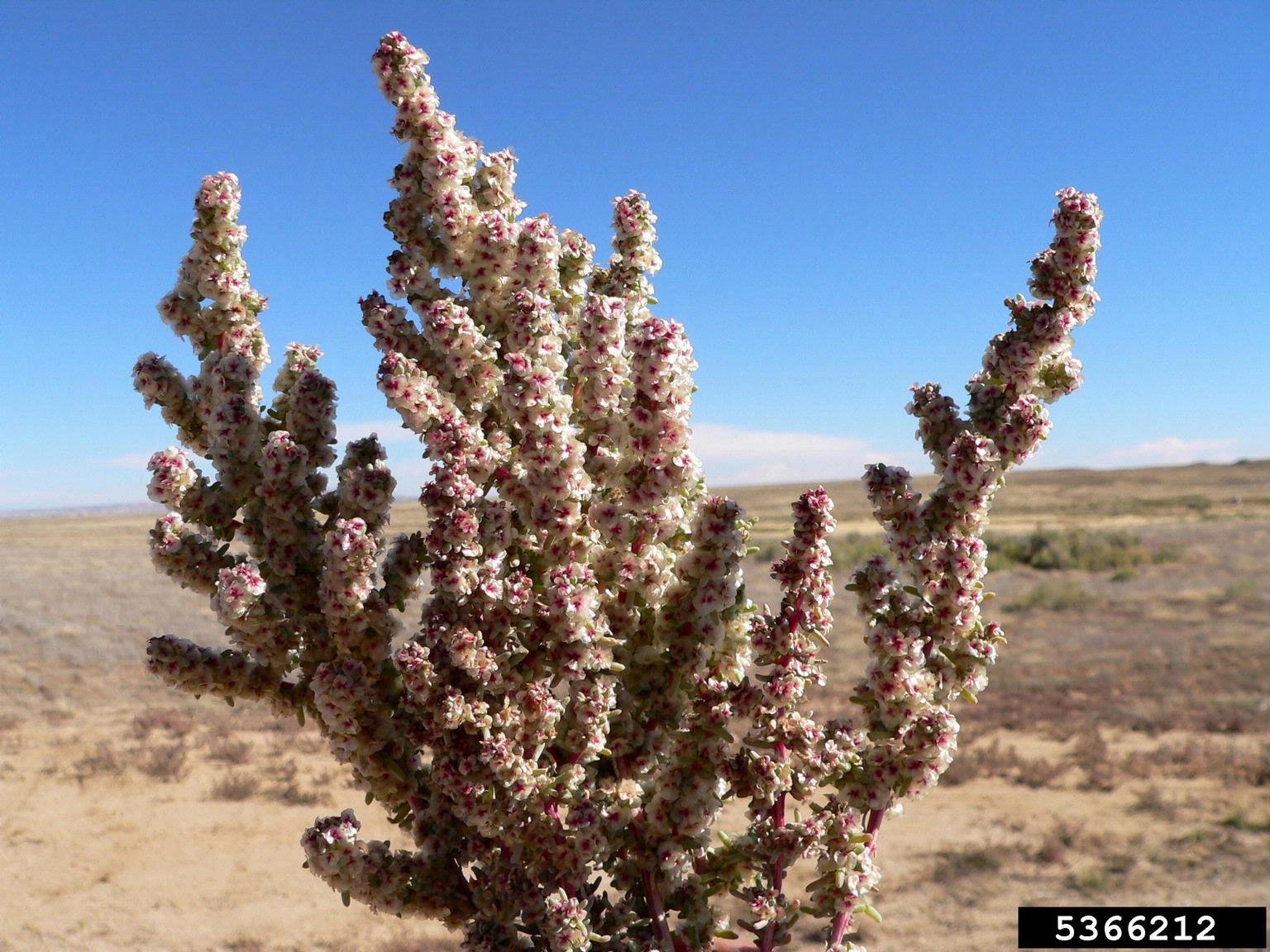
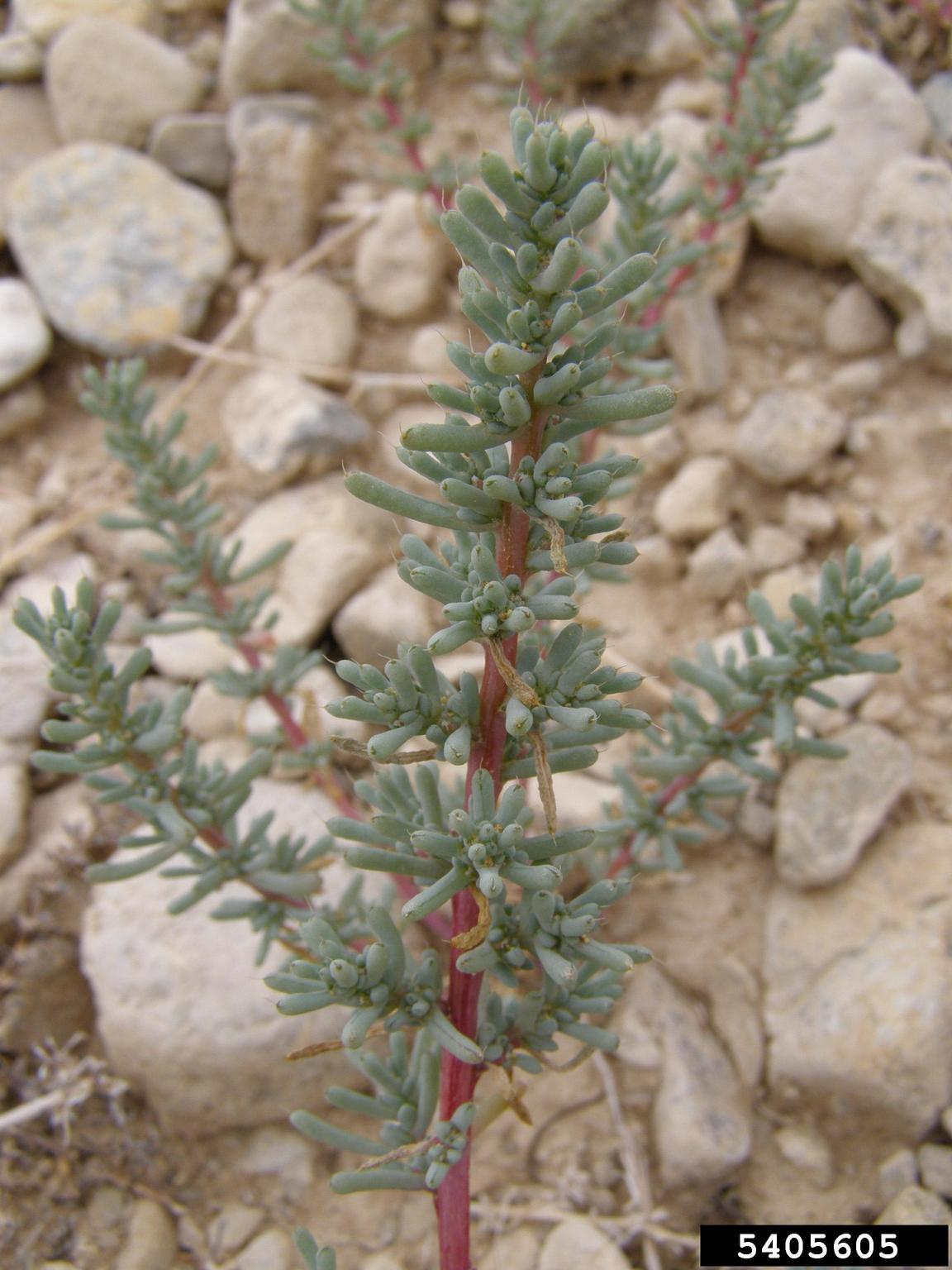
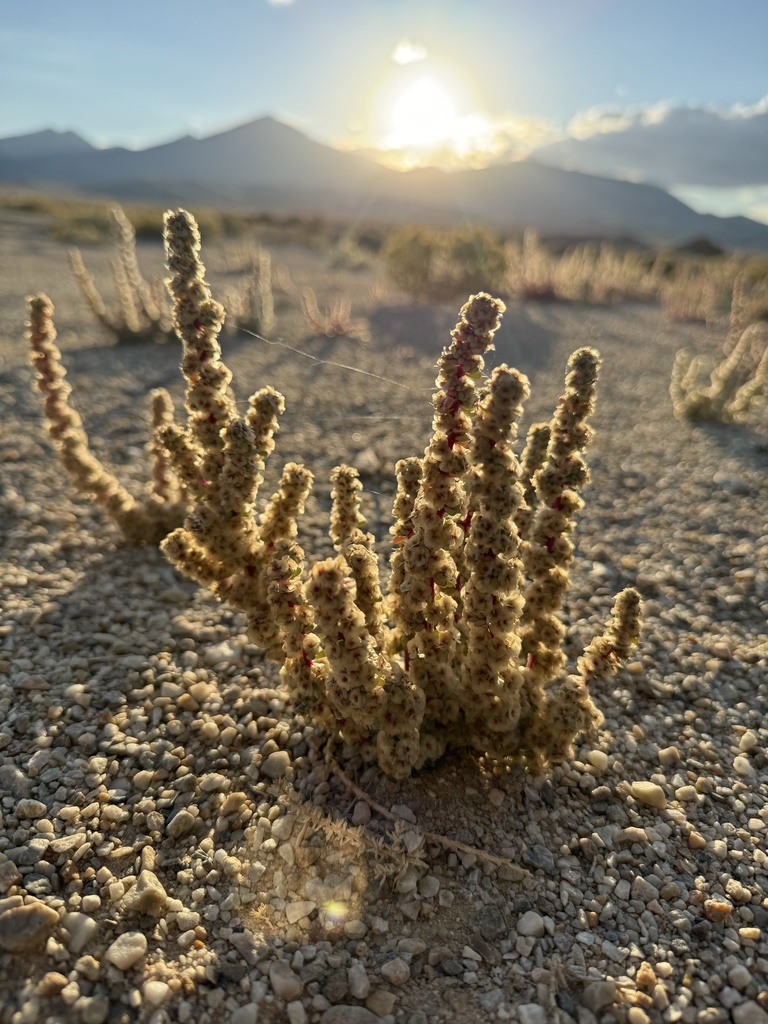
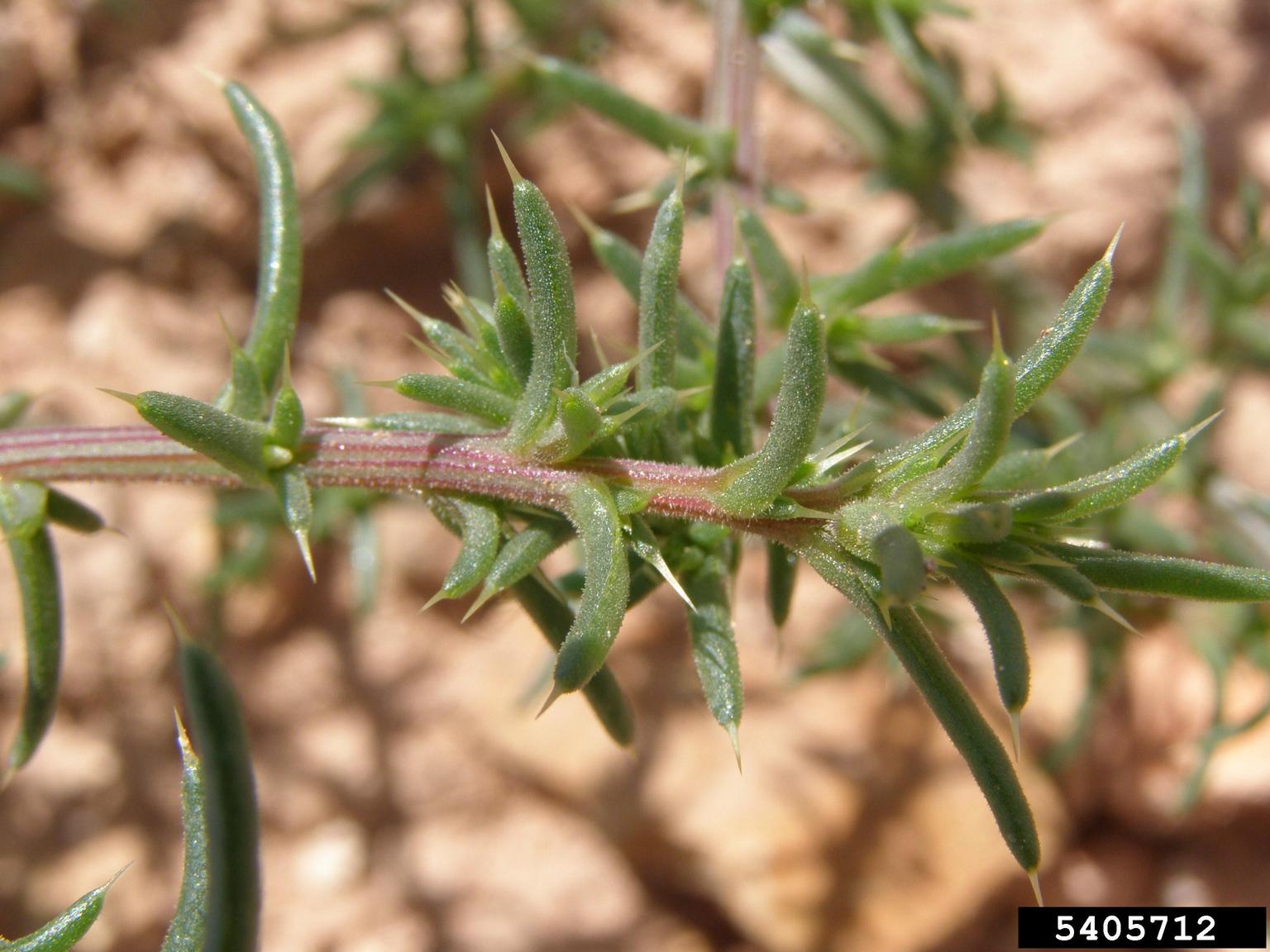
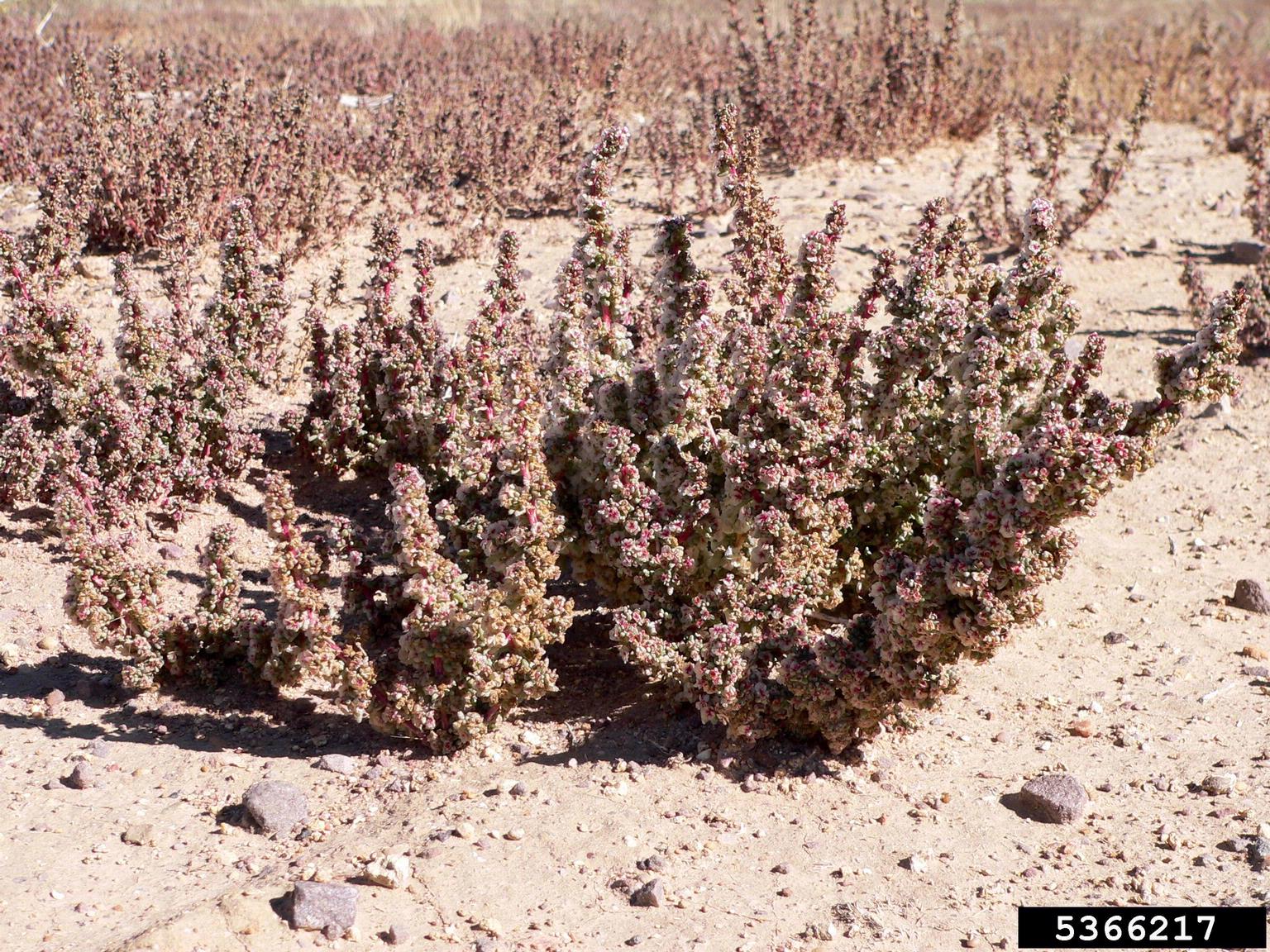
Halogeton is a succulent annual forb, usually 6-20 inches tall. It has short, sausage-like leaves about half an inch long and bluish-green. Its stem is red when mature, and its flowers are densely clustered, greenish-yellow to red. Before flowering, it can look similar to an immature russian thistle. Still, it can be differentiated by its cottony hairs on leaf axils and a singular bristle at the end of each leaf tip. [3,4,8,9]
Having trouble identifying a weed?
Contact your local conservation district or county extension agent.
Key Features
- Plant: Most of Halogeton stems branch from a long taproot, growing horizontally before curving upwards to about 12 inches tall. The stems are typically reddish-purple because of drought, but can be green with enough water. [3,6,9]
- Roots: Halogeton has a taproot that can grow 20 inches deep, and a radial spread of about 18 inches. [3, 5]
- Leaves: Leaves are arranged in an alternating pattern along the stems and have a narrow, lance‑like to softly elliptical form. Their edges are smooth, and the upper surface shows a muted gray‑green tone with a light covering of silvery, star‑shaped hairs and scales. The petioles and the underside of each leaf display a silvery gray color and a dense layer of silvery, shield‑like scales. [2,3]
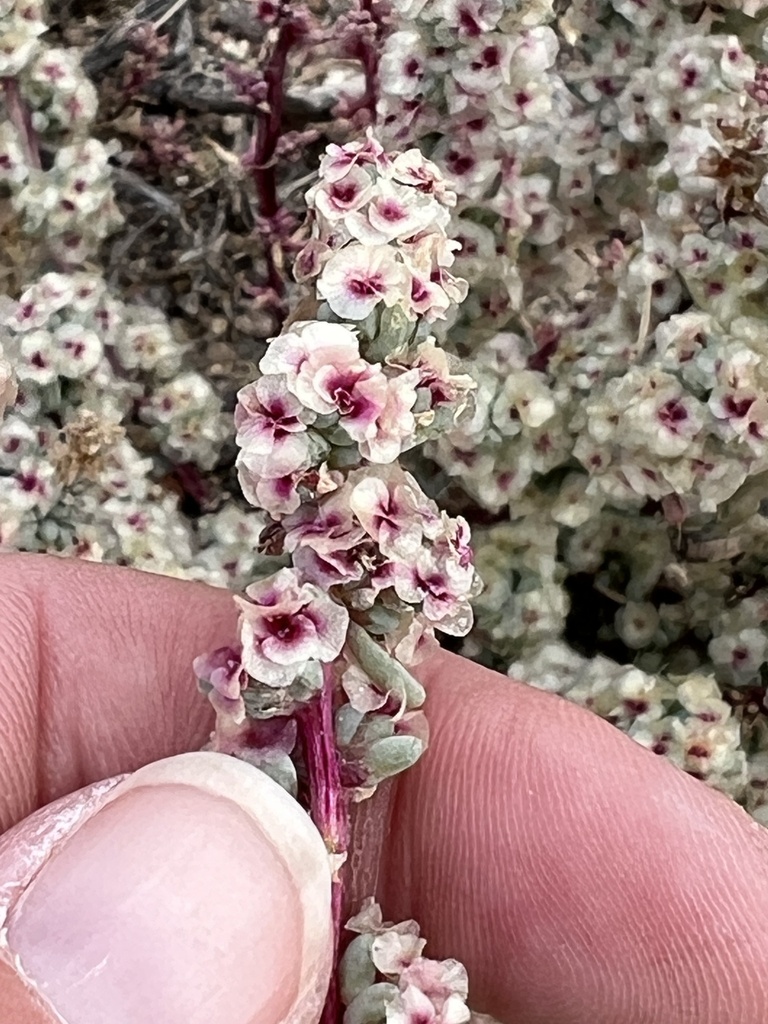
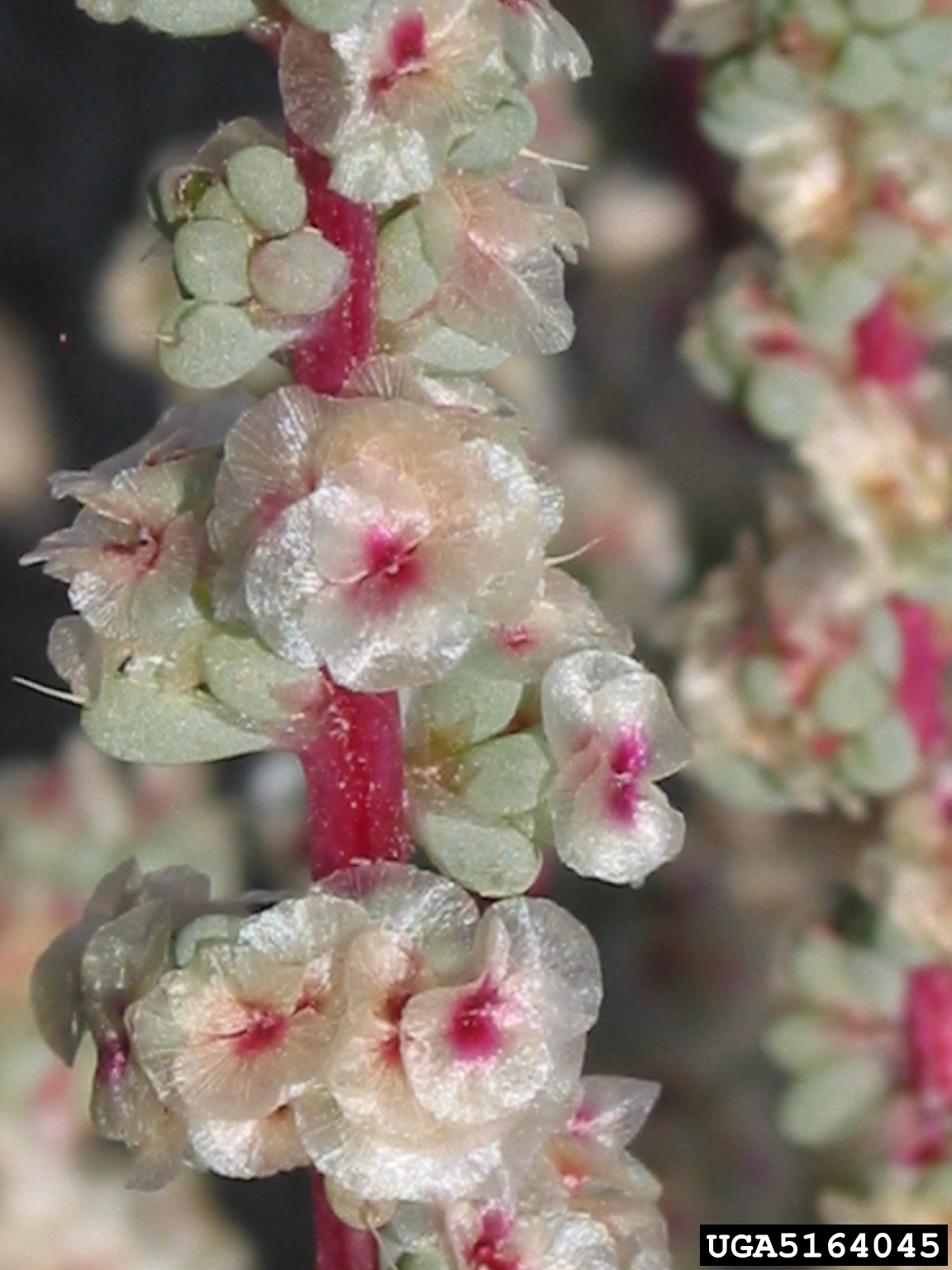
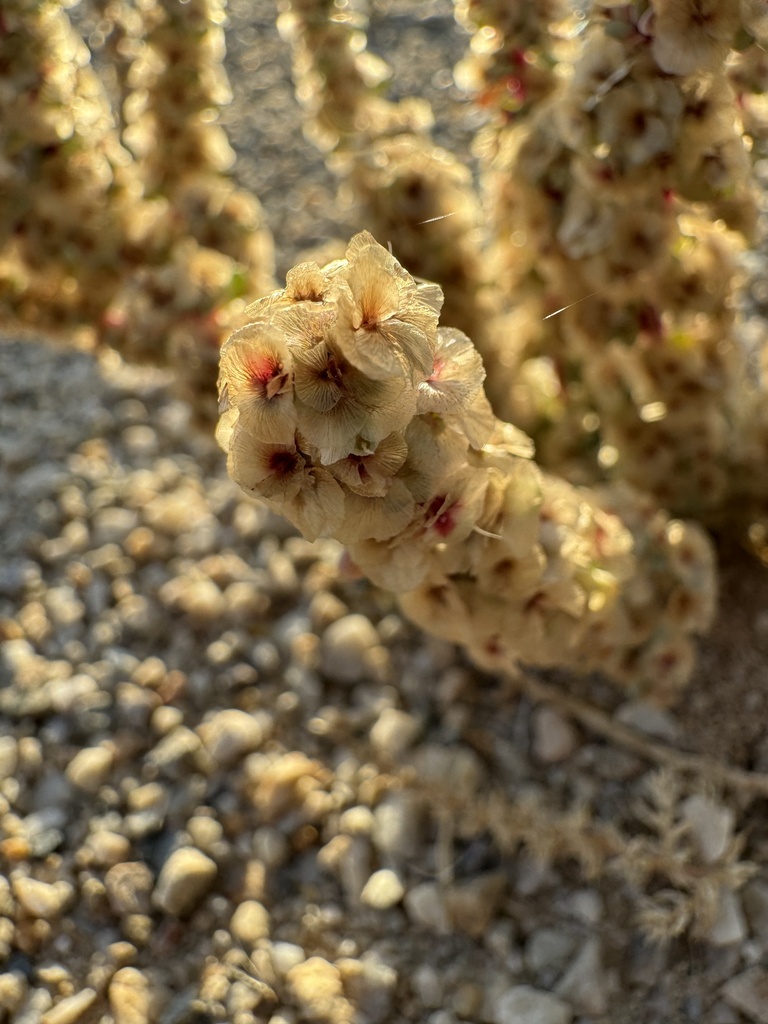
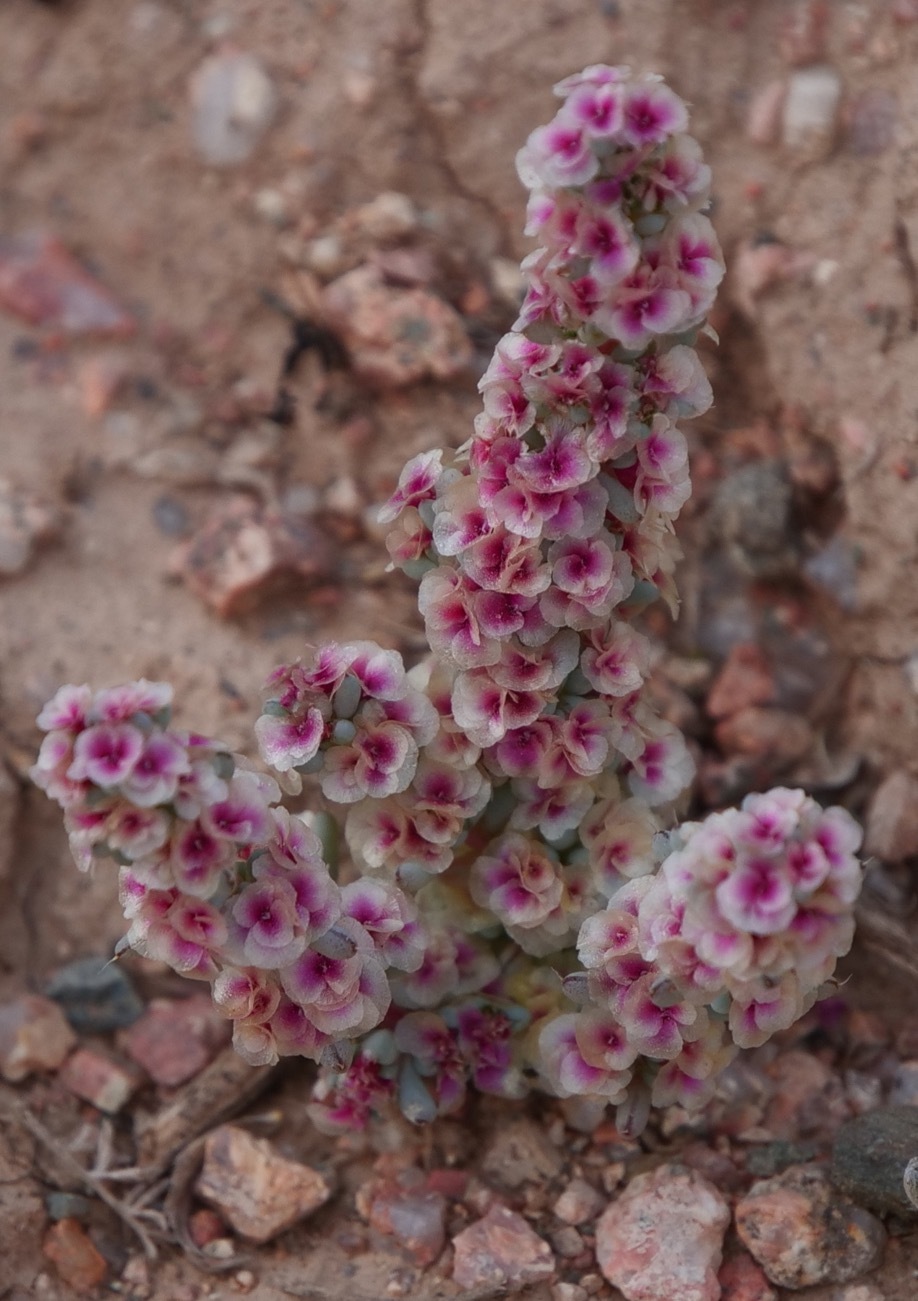
- Flowers: Halogeton can flower from June to September. They grow in thick clusters between the leaves and stem. The flowers lack petals; instead, they have petal-like sepals that are membranous and range from greenish-yellow to red. [1,3,4,9]
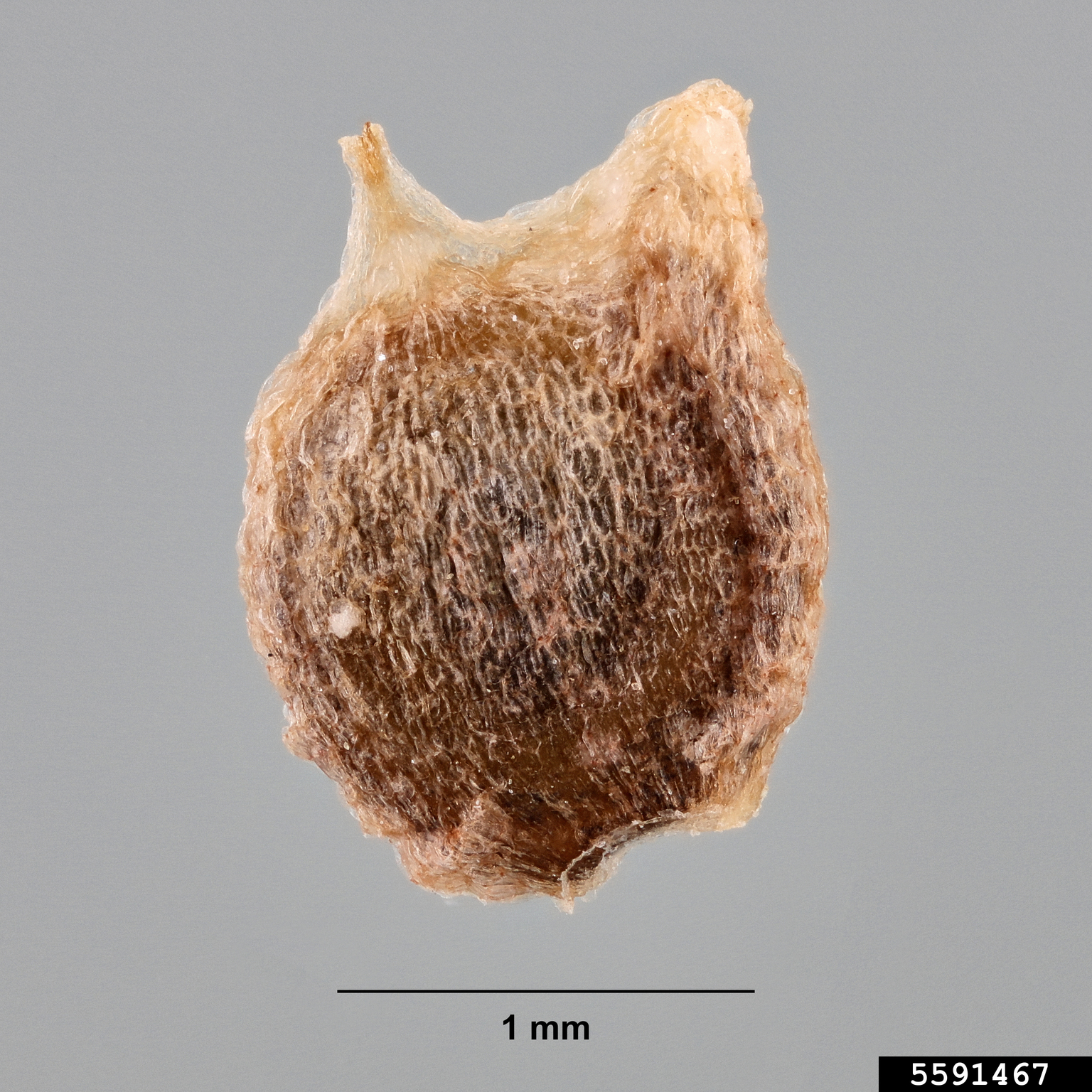
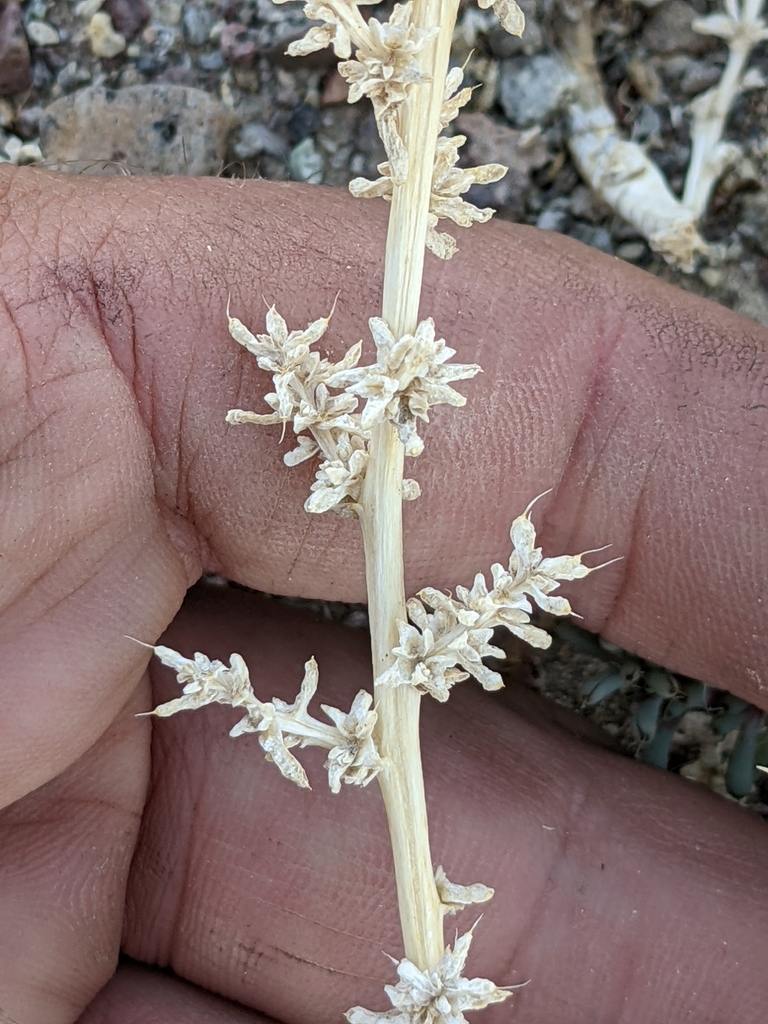
- Seeds: The seeds are found in thin-walled, one-seeded fruits. The fruits are often confused with flowers. They contain teardrop-shaped seeds that are either black or brown. Black seeds develop before August and are viable for a year, whereas brown seeds develop after August and can stay dormant for up to 10 years. [4,9]
Jennifer Duvall, inaturalist.org
The flowers lack petals; instead, they have petal-like sepals that are membranous and range from greenish-yellow to red.
B.Byambajav, inaturalist.org
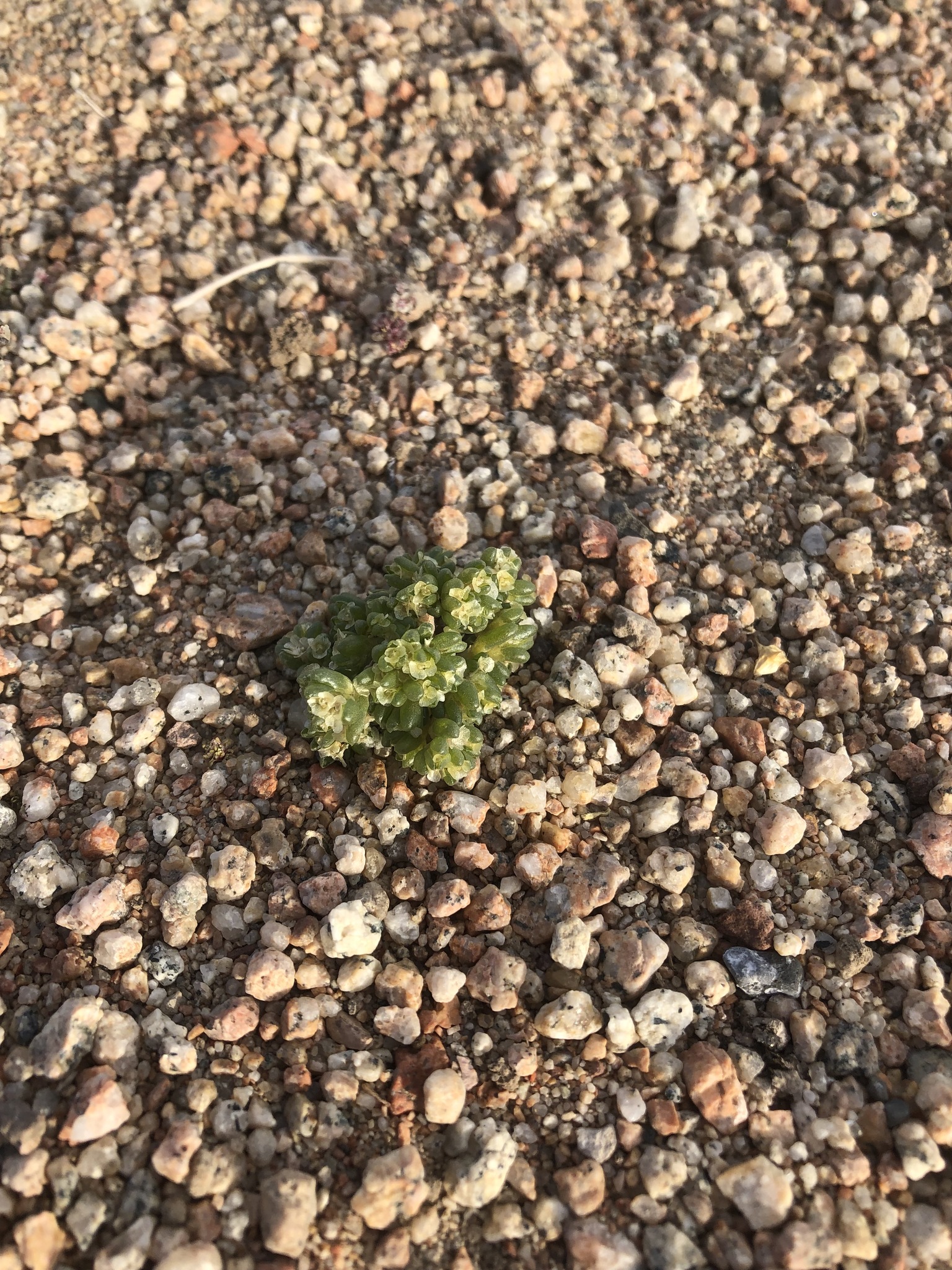
Seedlings usually germinate in April, but can grow from February to August. Halogeton remains a seedling and establishes its roots in cool weather, then rapidly grows vegetation in May.
Bonnie Million, Bureau of Land Management, Bugwood.org
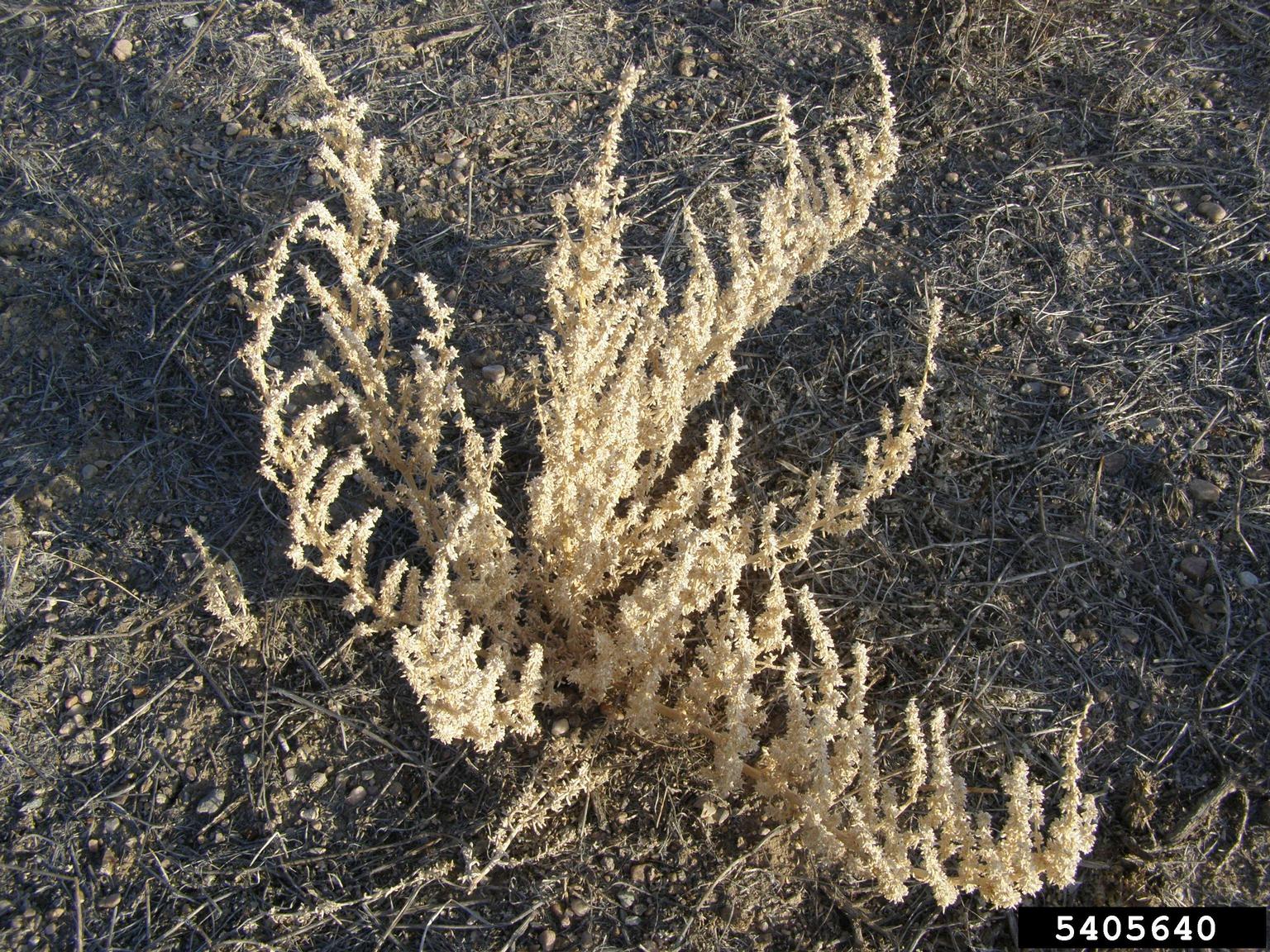
Halogeton remains a seedling and establishes its roots in cool weather, then rapidly grows vegetation in May.
Robert Johnson, inaturalist.org
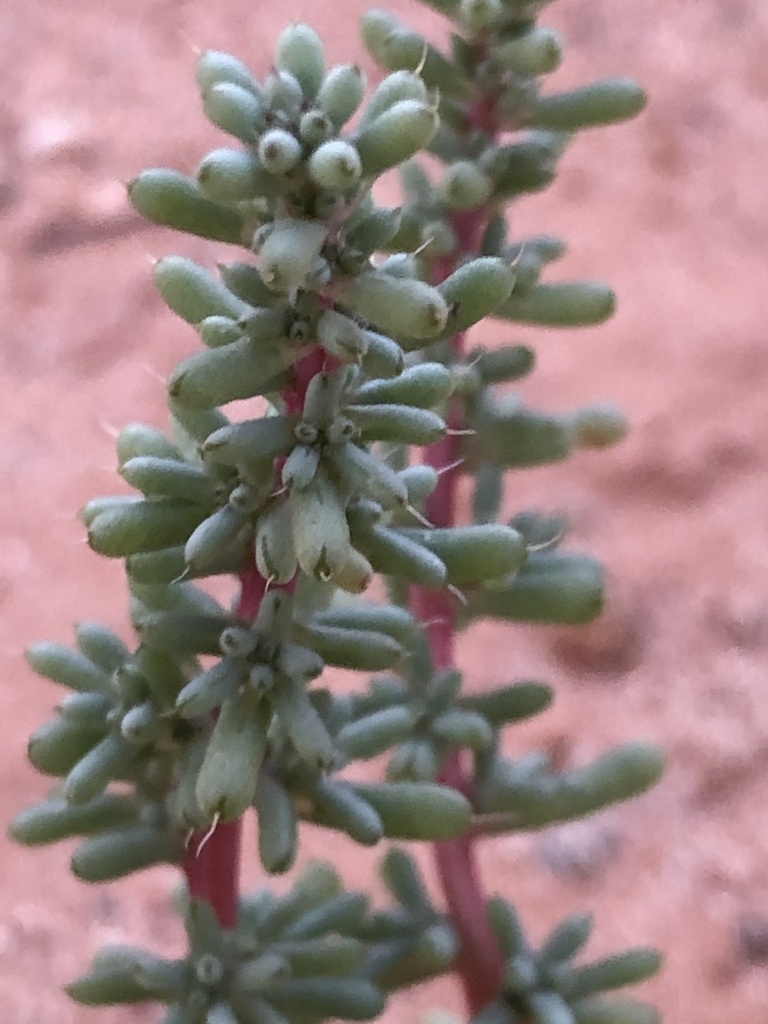
Halogeton leaves are small (half an inch) and bluish-green. They are cylindrical, and have a stiff bristle at the tip of each leaf.
Jennifer Duvall, inaturalist.org
Most of Halogeton stems branch from a long taproot, growing horizontally before curving upwards to about 12 inches tall.
Madeline Maher, APHIS, Bugwood.org
The fruits are often confused with flowers. They contain teardrop-shaped seeds that are either black or brown.
3. Infestation Basics
“Never turn hungry sheep onto dense halogeton-infested sites. When halogeton was the only feed available, they consumed too much, too rapidly, and were poisoned.”
– R. C. Gupta, 2018
Where does it grow, and how does it spread?
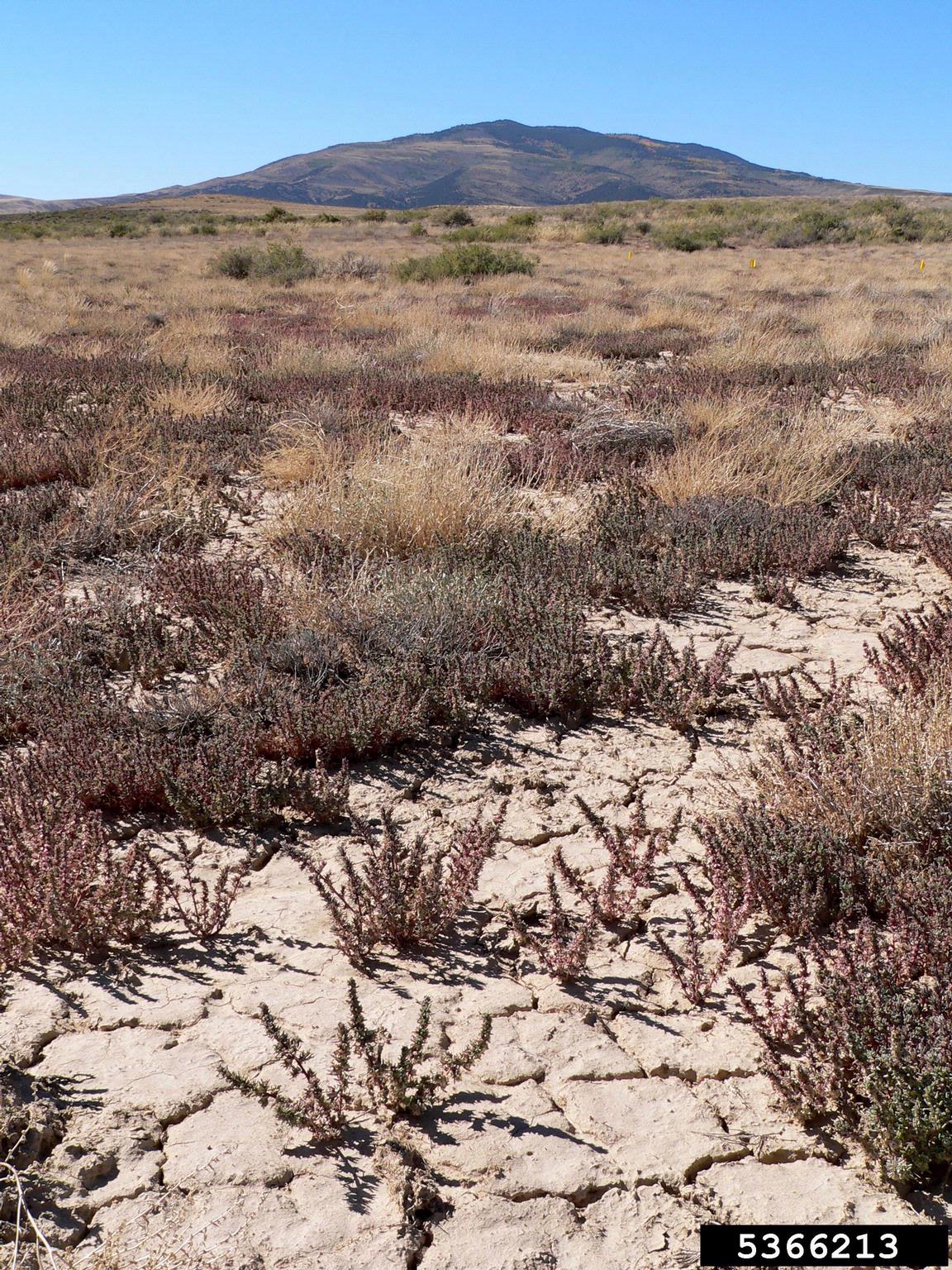
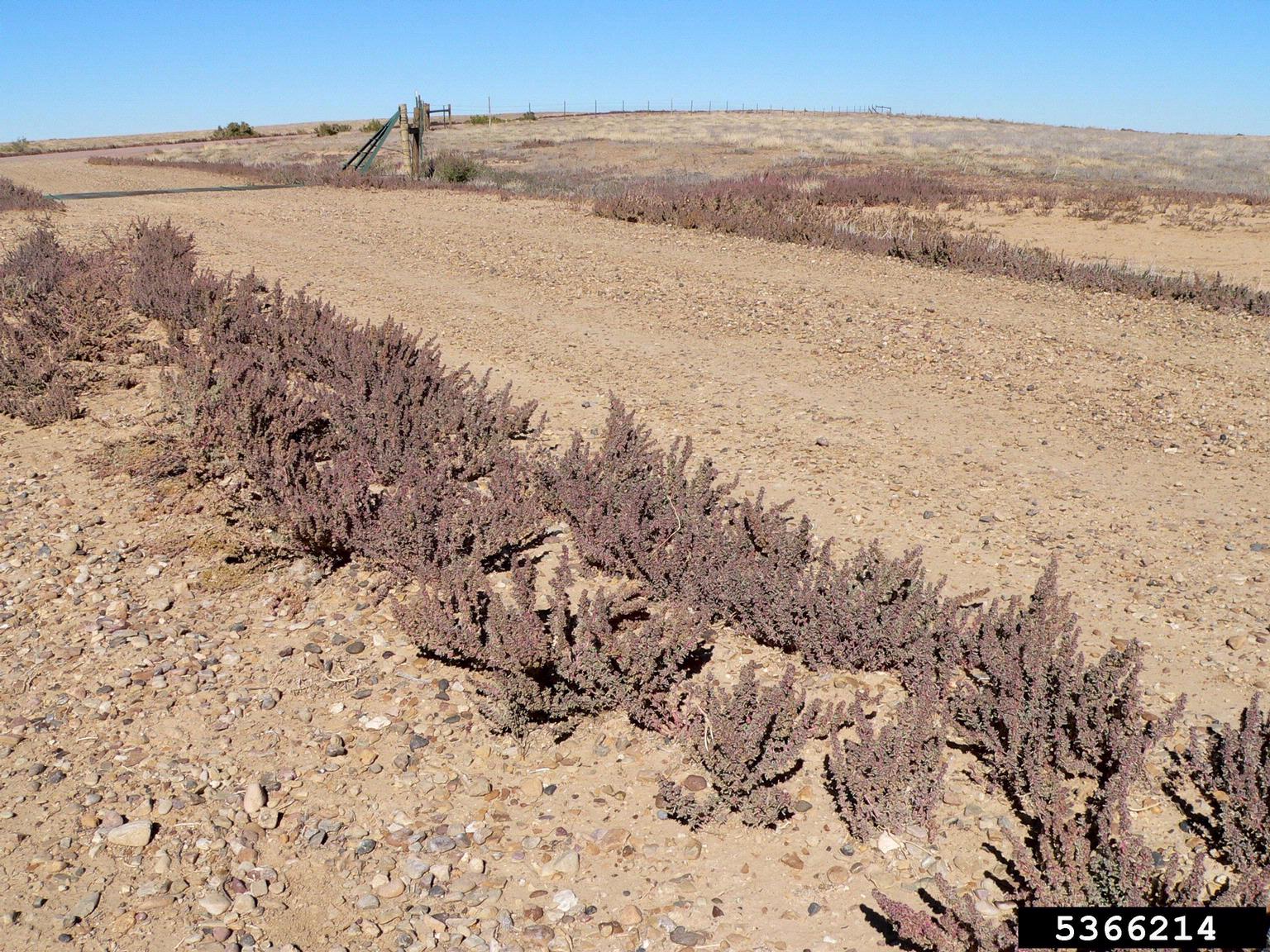
Halogeton grows in bare, disturbed areas such as overgrazed fields, roadsides, and abandoned places. It is highly toxic to livestock, especially sheep and cattle. It spreads by seeds that can spread through water, wind, and animal and human movement. [5]
Halogeton usually cannot compete with healthy vegetation, so it takes advantage of empty fields or abandoned areas. Once established, it begins to make soils more salty, limiting the ability of other plants to grow. It prefers alkaline and saline soils, semiarid environments, and areas with roughly 15 inches of annual precipitation. It usually invades open or disturbed areas, such as overgrazed rangelands, townsites, roadsides, railroads, and dry lake beds. [2,5,9]
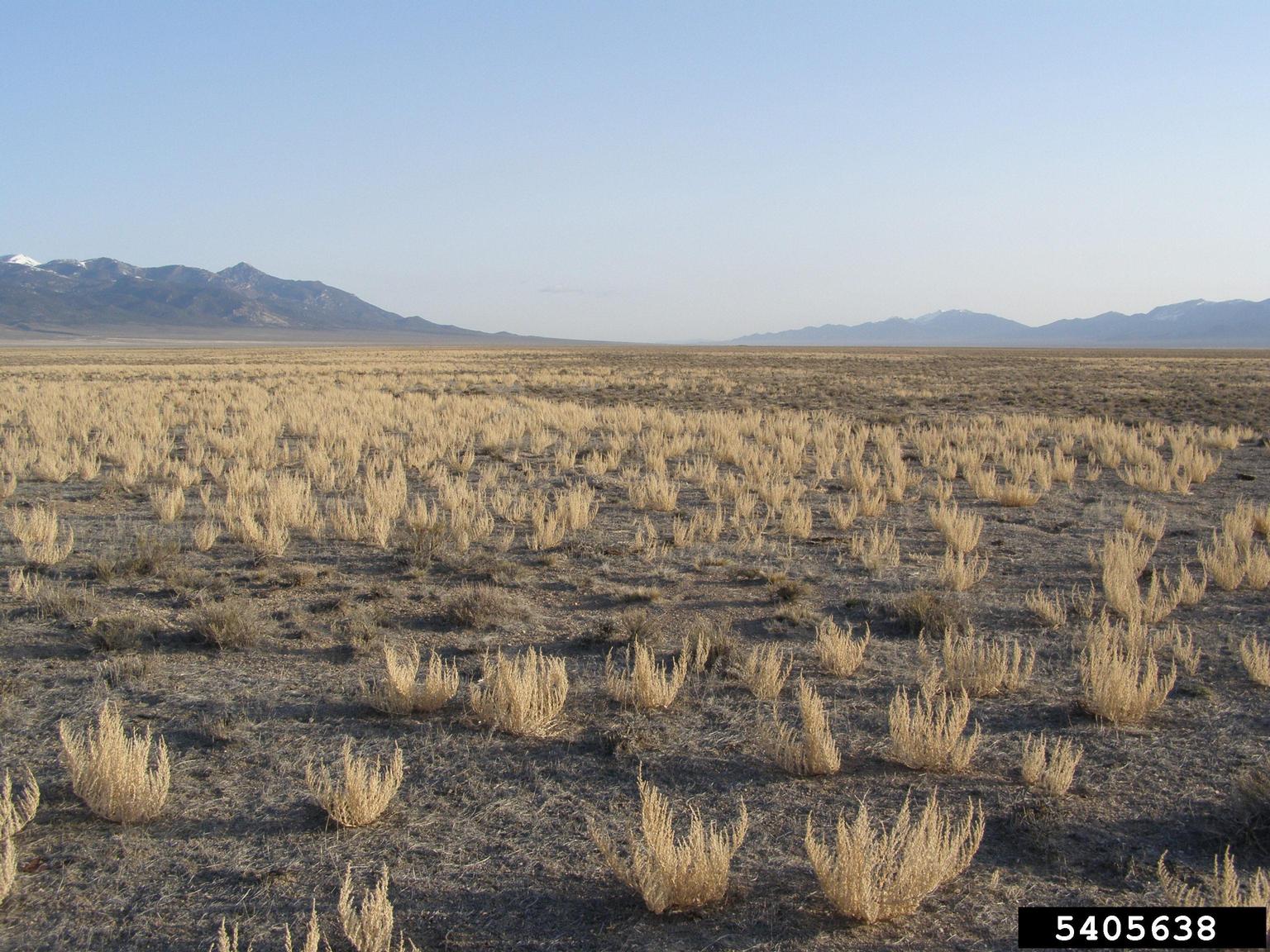
Halogeton is a fast-growing summer-winter annual that can thrive in areas with less than 12 inches of annual rain. It reaches its reproductive stage in mid-summer, or when soil moisture is limiting, and spreads seeds from July to October. Halogeton can only reproduce by seed, can produce as many as 25,000 seeds per plant, and can spread through wind, water, and animal or human activity. [2,3,8,9]
Seedlings usually germinate in April, but can grow from February to August. Halogeton remains a seedling and establishes its roots in cool weather, then rapidly grows vegetation in May. Most seeds are black and only last for a year, but a small percentage are brown and can survive for up to 10 years until favorable conditions return. [9,10]
Halogeton becomes more toxic as it matures, reaching peak toxicity at full maturity. It prefers alkaline soils and alters them as the plant matures by increasing pH and potassium, sodium, and magnesium levels, and decreasing water percolation, making it more difficult for other plants to establish. [2,5]
This plant can only spread by seed, but seeds are highly dispersible. They can spread through wind, water, animal movement, and human activity. Seeds are usually only viable for a year, but some can stay dormant for up to 10 years until favorable soil conditions return. Halogeton germination is dependent on precipitation, so abundance varies year to year. Halogeton is also shade-tolerant and highly adaptable to different environments [2,5,8,9]
Key takeaway: Halogeton is easily preventable by maintaining healthy cover plants. The areas most vulnerable are dry, salty soils that have been disturbed. Seeds can spread through wind, water, and animal movement.
Why is it so invasive?
These plants are highly toxic to all grazing animals. Affected fields should not be grazed, especially by sheep and cattle. Once animals are poisoned, there is no treatment available. They also make soils saline over time, making it more difficult for other plants to grow. [5,6]
All parts of the Halogeton plant contain potassium and sodium oxalate toxins, which cannot be detoxified when consumed. Poisoning occurs in sheep when they eat about 0.3% of their body weight. It causes weakness, muscle tremors, tetany, depression, and kidney failure. Coma and death can occur in as little as 12 hours after consumption. [6,8]
Halogeton also makes soils more saline and alkaline over time, making it difficult for other plants to grow around it. It cannot outgrow established crops, but it easily takes over open areas. [5]
Key takeaway: It produces abundant, widely dispersed seed, tolerates and thrives on disturbed and marginal sites, and converts diverse native riparian and upland communities into dense, low‑diversity stands that are difficult and costly to restore.
Common risk factors for invasion
- Overgrazing: When livestock are allowed to graze in a single area for too long, they will rip through the existing vegetation and expose the top layer of soil. This creates an opening for weed seeds, but this risk can be mitigated by practices that move cattle around more frequently, such as rotational grazing.
- Human activity: Halogeton thrives in areas where soil has been disturbed, such as construction sites, agricultural fields, roadsides, and other places where natural vegetation has been disrupted. These disturbances create openings in the soil, allowing the plant to become established. Additionally, the movement of soil, agricultural products, and equipment can inadvertently introduce the weed to new areas.
- Areas of neglect: This weed often establishes in neglected or abandoned places, such as roadsides, railways, and vacant lots. These undisturbed spaces give it the time and opportunity to spread without competition or control. Regular monitoring and weed management in such areas can mitigate this risk.
- Soil Disturbance: Halogeton readily invades areas with disturbed soil, such as construction sites, tilled fields, or overgrazed pastures. This disruption weakens existing vegetation, allowing the weed to become established. Minimizing unnecessary soil disturbance can help reduce the risk of invasion.
Impacts
Soil Degradation
Halogeton threatens agriculture by reducing land productivity. Halogeton also poses indirect threats to agriculture and natural resource conservation on the landscape by negatively impacting the quality. This weed contributes to soil degradation in New Mexico by altering the natural soil composition and structure. It increases soil salinity and pH and decreases moisture infiltration rate, hindering the regeneration of native vegetation, leading to long-term soil health issues and further degradation. [6,8,10]
Livestock
Many livestock graze on halogeton when hungry or thirsty, but it is highly toxic to ruminants, especially sheep and cattle. If more desirable vegetation is available, halogeton will be avoided, but as little as half a pound can kill a sheep. While livestock can adapt to oxalate-containing plants over time, treating an already poisoned animal is difficult, and the prognosis is usually poor. [6,8,10]
Economic
This weed reduces the available forage for domestic livestock and often causes harm to all livestock through oxalate poisoning, which usually leads to death. Affected fields should not be grazed on [8,10]
4. Management Strategies
Halogeton cannot outcompete healthy plants, so the best way to avoid this weed is to maintain healthy crops and avoid unnecessary soil disturbance. Because Halogeton is a simple-rooted annual, it can effectively be controlled through tillage or pulling. It is easiest to control as a seedling or early in its life before the plant reaches full maturity. Avoid overgrazing, fire, or other major soil disturbances, as these conditions favor halogeton germination. Leaving soil bare for long periods increases the likelihood of infestation. [3,5,8]
DO’s
- Plant native or other desirable species to avoid halogeton seeding.
- Pull or cut the halogeton while it is young and before it has seeded.
- Continue to check affected areas for regrowth to prevent further infestations.
DON’Ts
- Do not disturb the soil or leave it bare, as this gives time for the weed to spread.
- Leave to flower, as seeds appear quickly and are easily spread.
- Allow livestock to graze on halogeton, as it is poisonous.
** The following information is provided courtesy of the UC Weed Research and Information Center. nmweeds.org does not endorse the use of any particular product, brand, or application thereof. **
Because halogeton thrives on bare, saline, or overgrazed soils, improving grazing practices and maintaining consistent ground cover are key. Reseeding depleted areas with competitive perennial species helps limit new establishment, and preventing seed production through timely grazing or mowing can gradually reduce its presence. Long‑term success depends on restoring healthier soil conditions and minimizing the open, disturbed spaces where halogeton gains a foothold.
Mechanical (pulling, cutting, disking) |
Because halogeton is a simple, shallow-rooted annual, it can be controlled effectively by tillage or pulling. Plants are easiest to control as seedlings or in early vegetative growth. Plants not controlled until after flowering may contain seeds and should be removed and destroyed to prevent reseeding. Periodic mowing close to the soil surface can reduce but not completely prevent seed production. Surviving branches will continue to produce viable seeds. It is best to avoid increasing disturbance unless the successful restoration of perennials is highly probable. |
Disturbances such as overgrazing and fire typically reduce desirable vegetation and increase open sites with bare soil. This encourages the invasion and establishment of Halogeton. Any cultural control strategy should increase perennial vegetation, as Halogeton has been shown to compete poorly with established perennial species.
Grazing alone is not a control option because of the toxicity of the plant.
No biological control agents are available for the control of halogeton.
- CHEMICAL
- Growth Regulators
- Aromatic Aminoacid Inhibitors
- Branched Chain Aminoacid Inhibitors
- Photosynthetic Inhibitors
The following specific use information is based on published papers and reports by researchers and land managers. Other trade names may be available, and other compounds also are labeled for this weed. Directions for use may vary between brands; see label before use. Herbicides are listed by mode of action and then alphabetically. The order of herbicide listing is not reflective of the order of efficacy or preference.
|
2,4-D Several names |
Rate: 2 to 6 pt product/acre for ester formulation (0.95 to 2.85 lb a.e./acre) Timing: Postemergence in early spring when plants are growing rapidly before the bloom stage. Remarks: 2,4-D gives good, but not excellent, control and may damage desirable broadleaf natives, particularly at high rates. Reapplications are required to control subsequent germinants. Ester formulations are considered more effective than amine formulations. Apply with a crop oil concentrate for consistent control. Because of injury to native shrubs and a lack of desirable forage species adapted to alkali conditions, the use of 2,4-D for halogeton control has declined in recent years. |
|
Aminocyclopyrachlor + chlorsulfuron Perspective |
Rate: 3 to 4.5 oz product/acre Timing: Postemergence in early spring when plants are growing rapidly before the bloom stage. Remarks: Perspective provides broad-spectrum control of many broadleaf species. Although generally safe to grasses, it may suppress or injure certain annual and perennial grass species. Little is known of the herbicide for halogeton control, as its registration is relatively new. However, it has been shown to be very effective in herbicide trials. Do not treat in the root zone of desirable trees and shrubs. Do not apply more than 11 oz of product/acre per year. At this high rate, cool-season grasses will be damaged, including bluebunch wheatgrass. Not yet labeled for grazing lands. Add an adjuvant to the spray solution. This product is not approved for use in California and some counties of Colorado (San Luis Valley). |
|
Glyphosate Roundup, Accord XRT II, and others |
Rate: Spot treatment, 2% v/v solution Roundup ProMax Timing: Postemergence in summer before plants bloom. Remarks: Use as a spot treatment on small infestations. Repeat treatments are necessary to control flushes emerging later in the season. |
|
Chlorsulfuron Telar |
Rate: Label recommends 0.5 to 1 oz product/acre (0.375 to 0.75 oz a.i./acre), but field results have shown 0.2 to 0.5 oz product/acre (0.15 to 0.375 oz a.i./acre) to be effective. Apply with surfactant. Timing: Postemergence in late spring or early summer when plants are only 1 to 3 inches tall. Remarks: Chlorsulfuron has been shown to be more effective than metsulfuron in western rangelands. Chlorsulfuron can damage some native shrubs, including Nuttall’s saltbush (Atriplex nutalllii). Chlorsulfuron is considered the most effective herbicide for control of halogeton in rangelands. |
|
Imazapic Plateau
|
Rate: 4 to 6 oz product/acre (1 to 1.5 oz a.e./acre) Timing: Preemergence or early postemergence to seedlings 1 to 3 inches tall. Remarks: For postemergence application, add a surfactant at about 1.5 oz/acre. Imazapic is selective to most native grasses, but will injure some species. Higher rates may suppress seedlings of some cool-season grasses. Imazapic is not registered for use in California. |
|
Metsulfuron Escort
|
Rate: 0.5 to 1 oz product/acre (0.3 to 0.6 oz a.i./acre). Apply with surfactant. Timing: Postemergence in the late spring or early summer when seedlings have emerged and are growing rapidly, generally 1 to 3 inches tall. Remarks: Metsulfuron does not cause injury to grasses and this may be a desirable feature in areas with crested wheatgrass or other forage grasses. Metsulfuron is not registered for use in California. |
| Tebuthiuron Spike |
Tebuthiuron is a pelleted formulation that provides total vegetation control for several years and may be desirable for use on railroad ballast and oil field locations, where halogeton is often found. It has a very long soil residual activity and will provide total vegetation control for 3 to 5 years. |
6. References
Citations
[1] MTNHP, “Halogeton – Montana Field Guide,” Mt.gov, 2025. Available: https://fieldguide.mt.gov/speciesDetail.aspx?elcode=PDCHE0D010 . [Accessed: Jul. 01, 2025]
[2] “Halogeton (Halogeton glomeratus): USDA ARS,” www.ars.usda.gov, Jun. 26, 2018. Available: https://www.ars.usda.gov/pacific-west-area/logan-ut/poisonous-plant-research/docs/halogeton-halogeton-glomeratus/
[3] U. NRCS, “Plant Guide Halogeton Halogeton glomeratus (M. Bieb.) Meyer.” Available: https://www.nrcs.usda.gov/plantmaterials/idpmcpg7795.pdf
[4] “IPCW Plant Report – California Invasive Plant Council,” Cal-ipc.org, 2025. Available: https://www.cal-ipc.org/resources/library/publications/ipcw/report53/ . [Accessed: Jul. 02, 2025]
[5] D. S. Pavek, “Halogeton glomeratus,” Fire effects information system, 1992. Available: https://www.fs.usda.gov/database/feis/plants/forb/halglo/all.html
[6] “Guide to Poisonous Plants – College of Veterinary Medicine and Biomedical Sciences – Colorado State University,” poisonousplants.cvmbs.colostate.edu. Available: https://poisonousplants.cvmbs.colostate.edu/plant/72
[7] “NMSU: Selected Plants of Navajo Rangelands,” Nmsu.edu, 2018. Available: https://navajorange.nmsu.edu/detail.php?id=9 . [Accessed: Jul. 02, 2025]
[8] G. Cafà, “Halogeton glomeratus (halogeton),” CABI Compendium, Jan. 2022, doi: https://doi.org/10.1079/cabicompendium.26352
[9] “Exotic Species: Halogeton (U.S. National Park Service),” Nps.gov, 2016. Available: https://www.nps.gov/articles/halogeton.htm
[10] R. C. Gupta, Veterinary Toxicology: Basic and Clinical Principles. London: Elsevier/Academic Press, 2018, pp. 837–889.
K. George Beck and James Sebastian, Colorado State University, Bugwood.org
Clinton Shock, Oregon State University, Bugwood.org
Fun Facts
The name Halogeton comes from the Greek roots hals, meaning salty, and geiton, meaning neighbor, and “glomeratus” means clustered. [9]
K. George Beck and James Sebastian, Colorado State University, Bugwood.org
K. George Beck and James Sebastian, Colorado State University, Bugwood.org
Fun Facts
Halogeton is widely studied for its tolerance to salinity stress. Research on this plant helps better understand salt stress on crops and other plants. It is also being studied for its effects on mammals and for possible treatments for its poisoning. [8]
Bonnie Million, Bureau of Land Management, Bugwood.org
Bonnie Million, Bureau of Land Management, Bugwood.org
Fun Facts
Because of its rapid effects on livestock, Congress passed the Halogeton Act in 1952 to detect halogeton, determine its effects, and control and eradicate the weed. They discovered that, in general, livestock avoid the plant unless they are starving, so one way to prevent poisoning is to ensure that cattle are eating sufficient amounts. [10]
Andrew, inaturalist.org
Bonnie Million, Bureau of Land Management, Bugwood.org
Andrew, inaturalist.org
Kyle Brine, inaturalist.org
K. George Beck and James Sebastian, Colorado State University, Bugwood.org
laurencedel, inaturalist.org