

Maltese Starthistle
Centaurea melitensis
Class B
Llimited to portions of the state. In areas with severe infestations, management should be designed to contain the infestation and stop any further spread.
Agricultural Threat
This plant threatens our state’s food security and economy by reducing agriculture yields and/or degrading soil resources.
Toxic to Horses
This plant has been documented to sicken or injure horses.
Children & Pets
This plant may pose a particular risk to unsupervised children and animals due to its toxicity or potential for injury.
QUICK FACTS
- Maltese starthistle can grow up to 3 feet tall, with a taproot of up to 3 feet deep. It has a small yellow flower with purplish-brown spikes surrounding the base of the flowerhead. This weed has deeply lobed, dark green basal rosettes. The stem is a lighter green, with small, bristly hairs.
- Maltese starthistle is an annual forb native to the Mediterranean. It was introduced to the U.S. in the 1700s through Spanish colonization. It spread through western and southern states, but couldn’t establish itself in eastern and northern states. It continues to affect disturbed open areas in these regions.
- This weed is very similar to yellow starthistle. The main differences are that Maltese starthistle is smaller, slightly less toxic, and spreads less easily. Maltese starthistle also sprouts earlier and dries out quicker than yellow starthistle.
1. Overview
A difficult weed in many western and southern states.
Maltese starthistle quickly took over open fields after its introduction in the 1700s. It spread through contaminated seeds and human movement. While it struggles to compete with neighboring plants, it can quickly take over disturbed areas because it grows quickly and produces hundreds of seeds. In New Mexico, it mainly affects southern counties but threatens native species like Wright’s marsh thistle by altering habitats and competing for resources.
History of Russian Olive
Maltese starthistle is native to the Mediterranean region of Europe and Africa. It was accidentally spread worldwide through contaminated grain seeds in the 1700s during colonization by Spain and Portugal. The earliest record of this weed in the U.S. was seeds found in adobe bricks dated back to 1797 in California. [1,2,3]
Maltese starthistle continued to spread through the U.S. in the 1800s through contaminated grain seeds, especially in dry-farmed fields. However, it failed to establish itself in eastern and northern states. Currently, it is listed as a noxious weed in New Mexico, California, Nevada, and Arizona, where it mainly affects grasslands, open fields, and other disturbed sites. [3,4]
2. ID Guide
What does it look like?
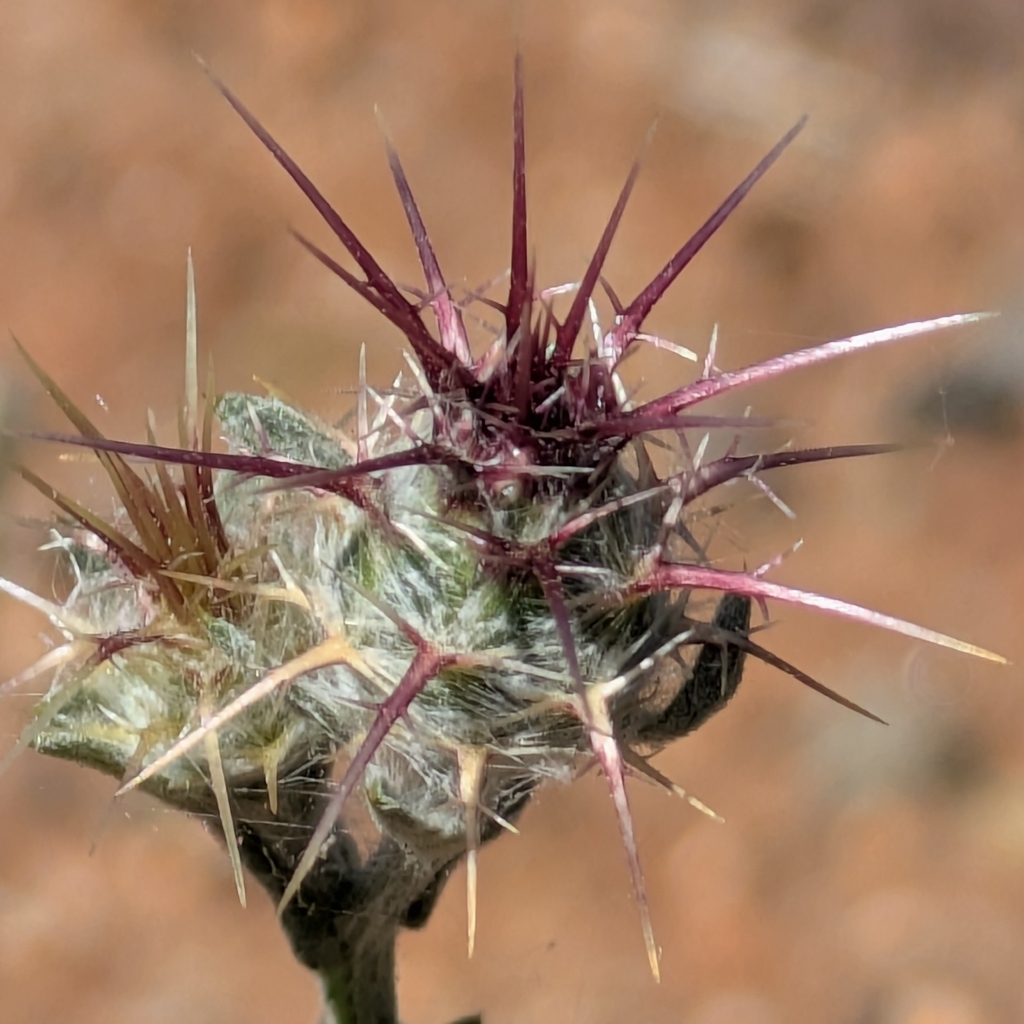
Maltese starthistle is an annual with gray-green stems and leaves. It has a small thistle-like flower surrounded by spikes, growing to about 2 feet tall. Stems and leaves are covered in small, stiff hairs. This plant is often confused with yellow starthistle because of its yellow flowers, but it can be distinguished by size and color. The Maltese starthistle is shorter (1-2 feet) and has a smaller flowerhead (1/2-5/8 inch), and its spikes are purplish-brown and shorter (1/5-1/2 inch). [3,5]
Having trouble identifying a weed?
Contact your local conservation district or county extension agent.
Key Features
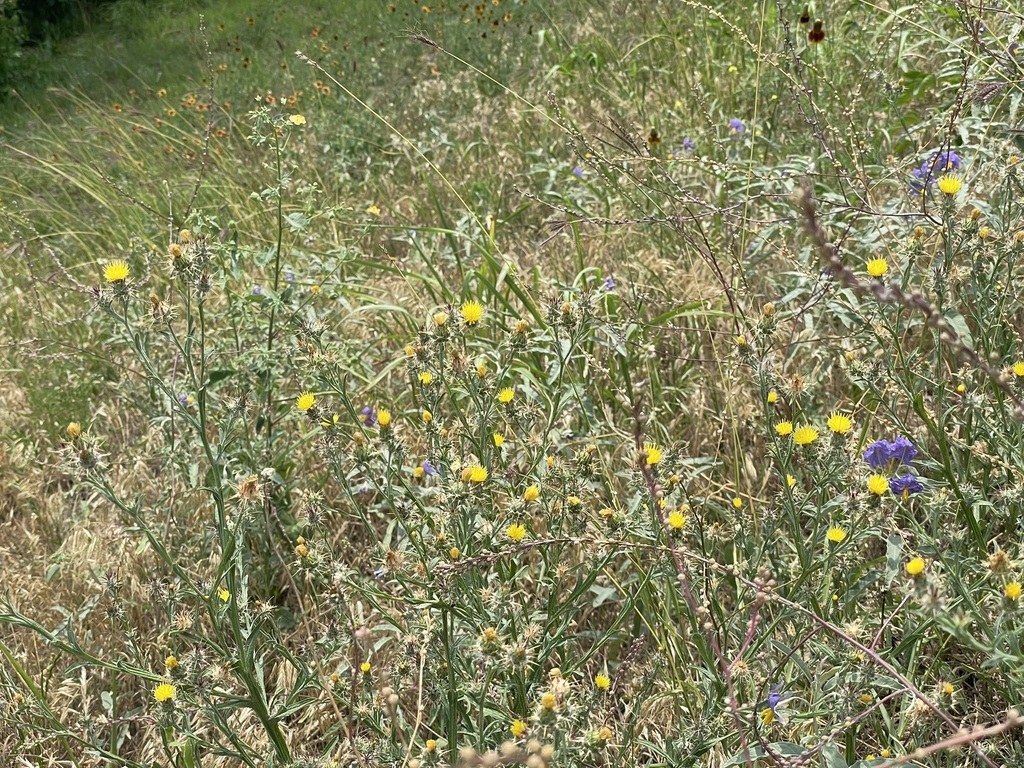
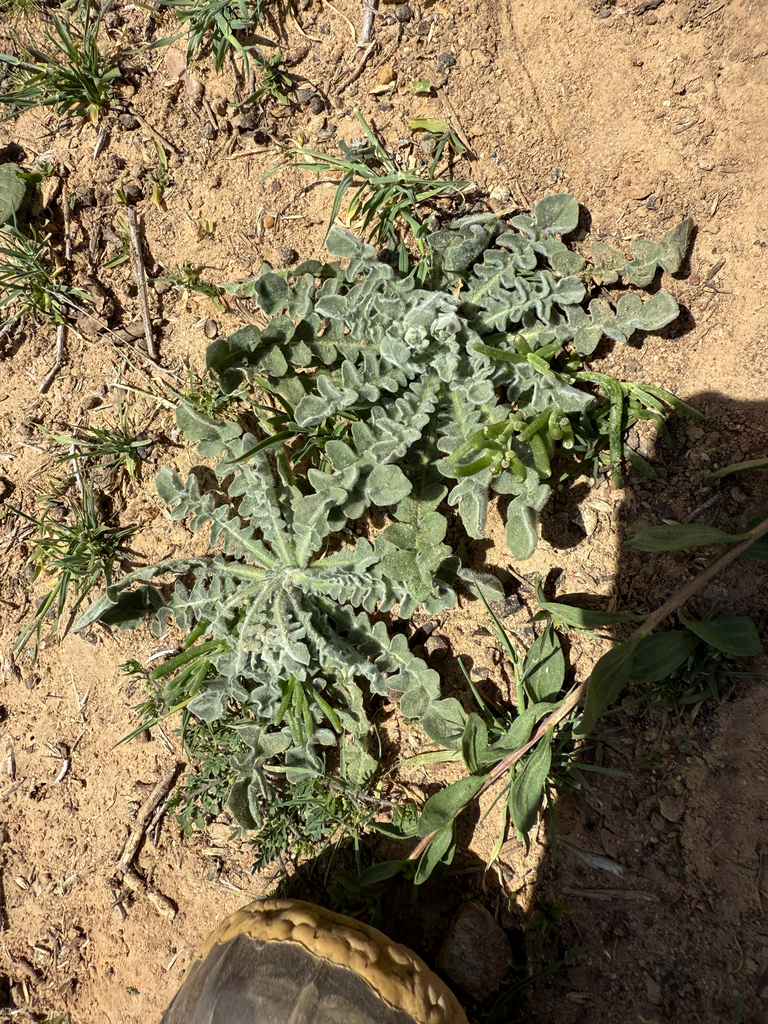
- Plant: Maltese starthistle is an annual that can germinate from fall through early spring. It starts as a basal rosette of entire, dark grey-green leaves, and becomes deeply lobed as it matures. After bolting in spring, they can grow up to 3 feet tall in ideal conditions, but are usually around 2 feet tall. They have a yellow thistle-like flower from April to June on top of the grey-green stems that appear winged. [2,4]
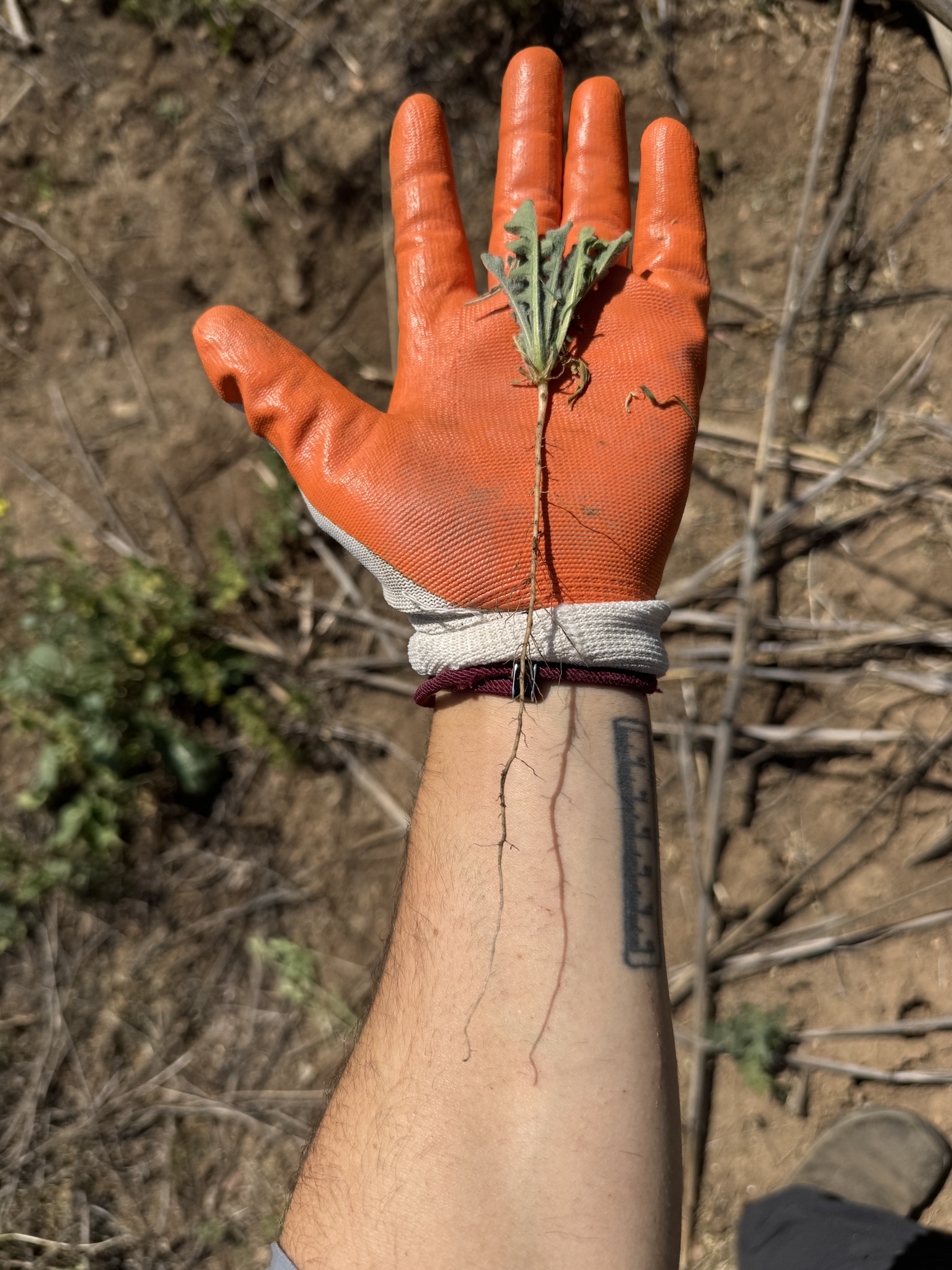
- Roots: This weed forms a simple taproot through winter and spring. They cannot penetrate as deeply into the soil as their lookalike, yellow starthistle, so roots are shorter than 3 feet deep. [3,4]
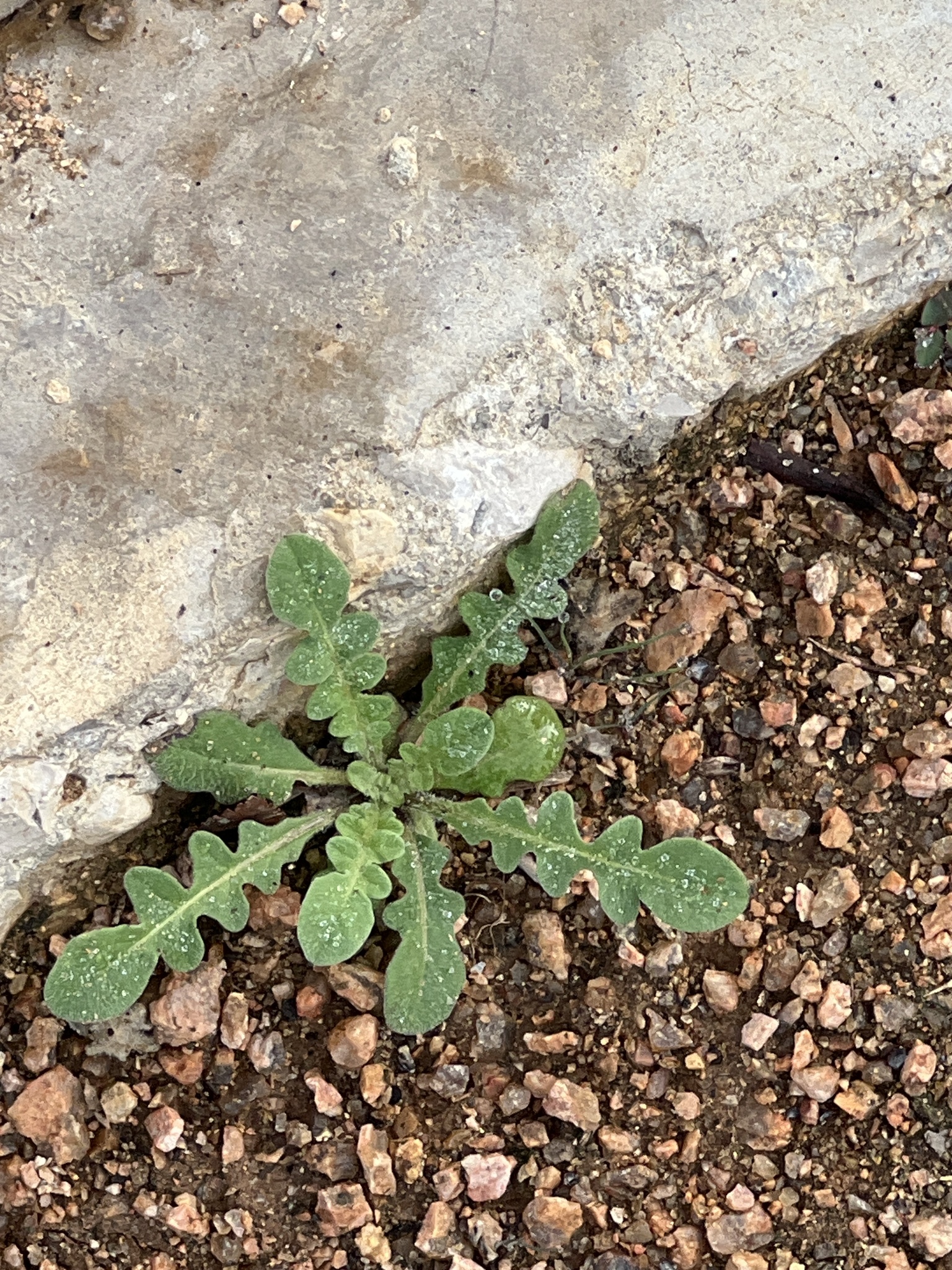
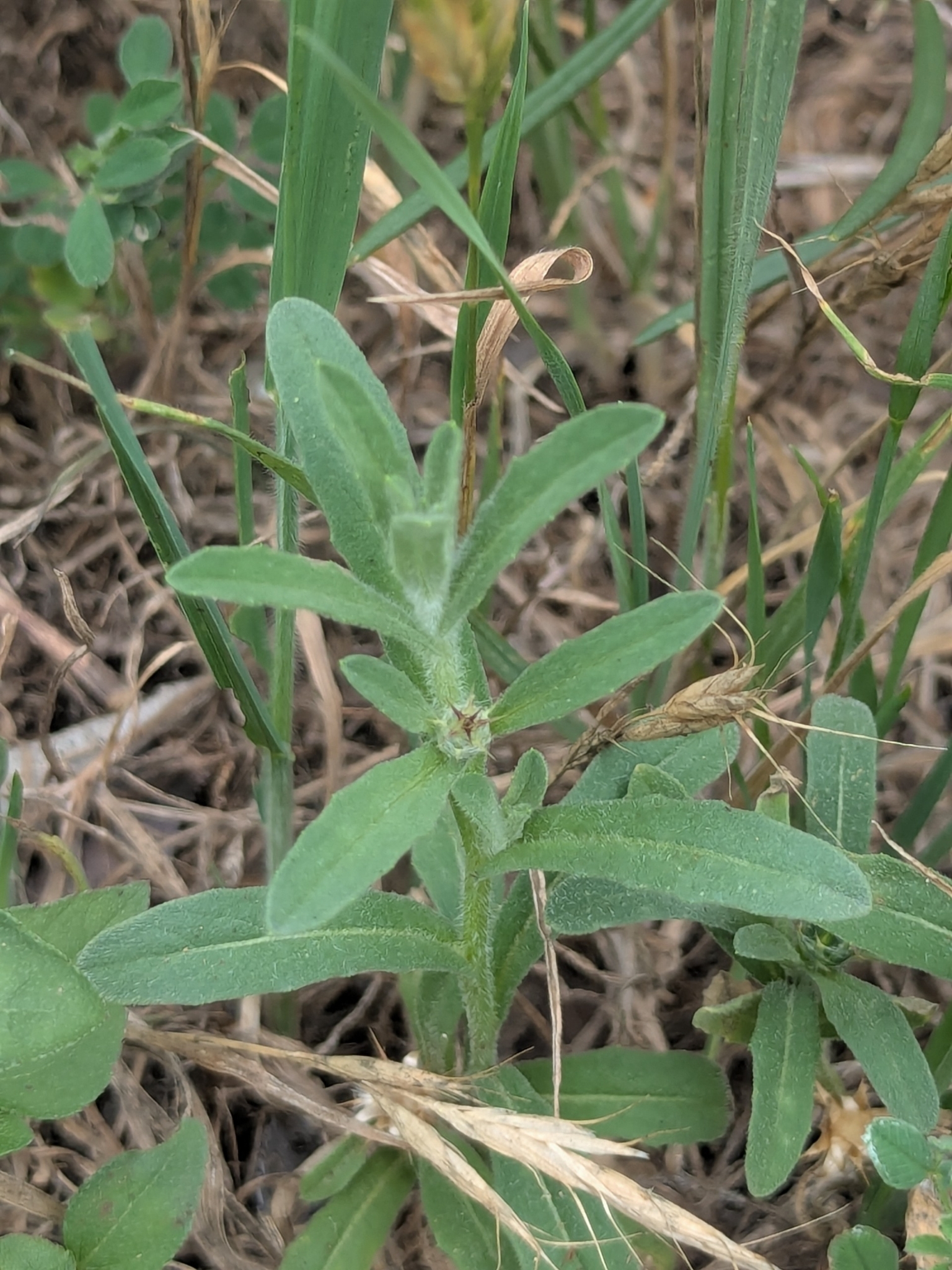
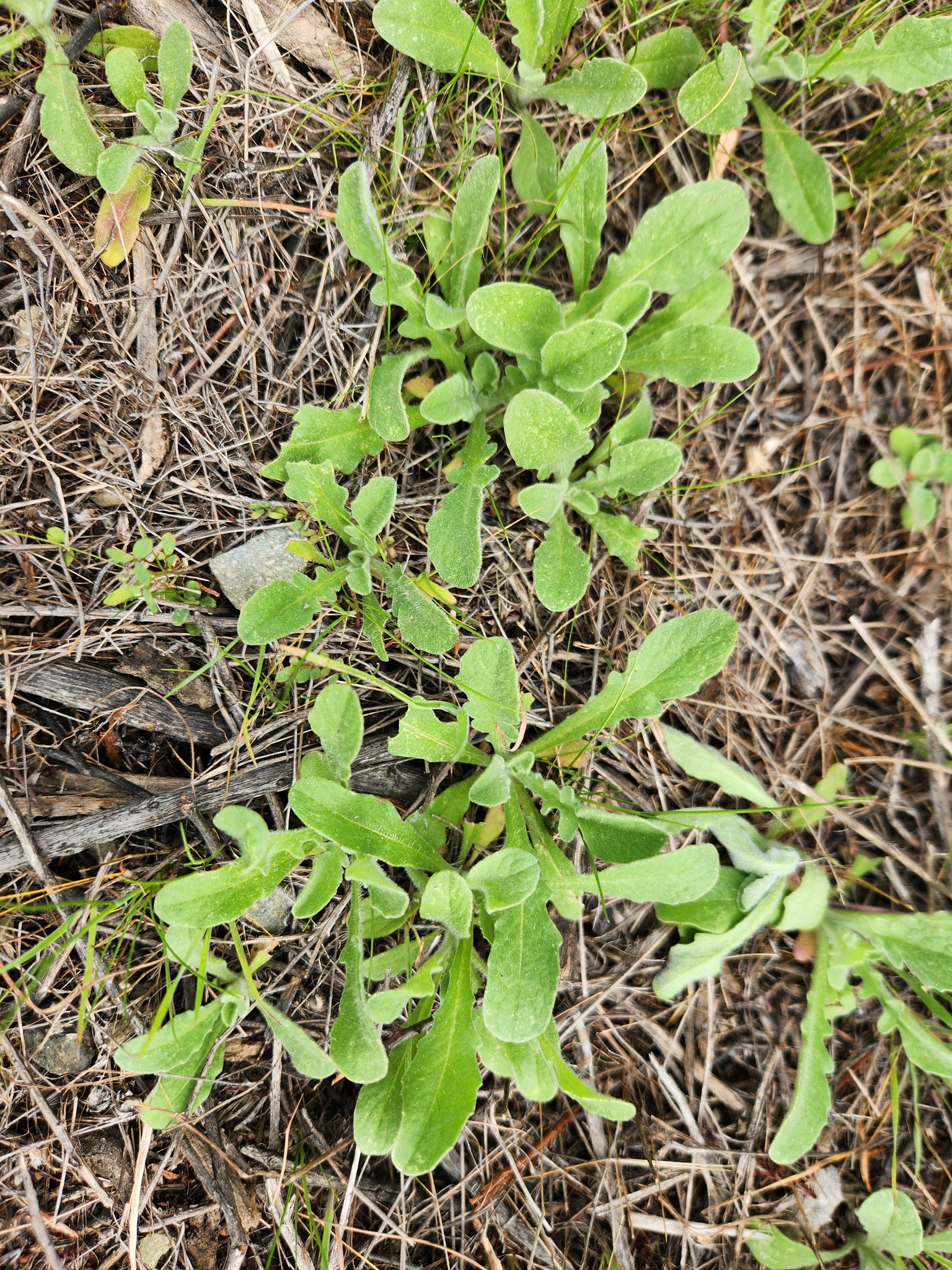
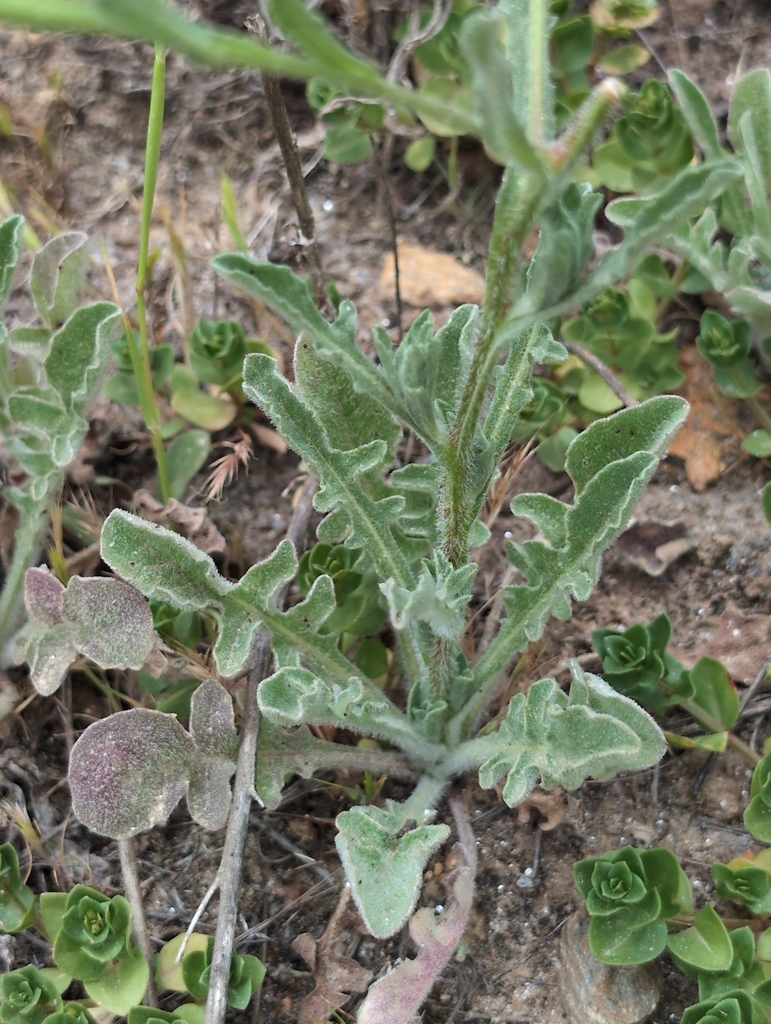
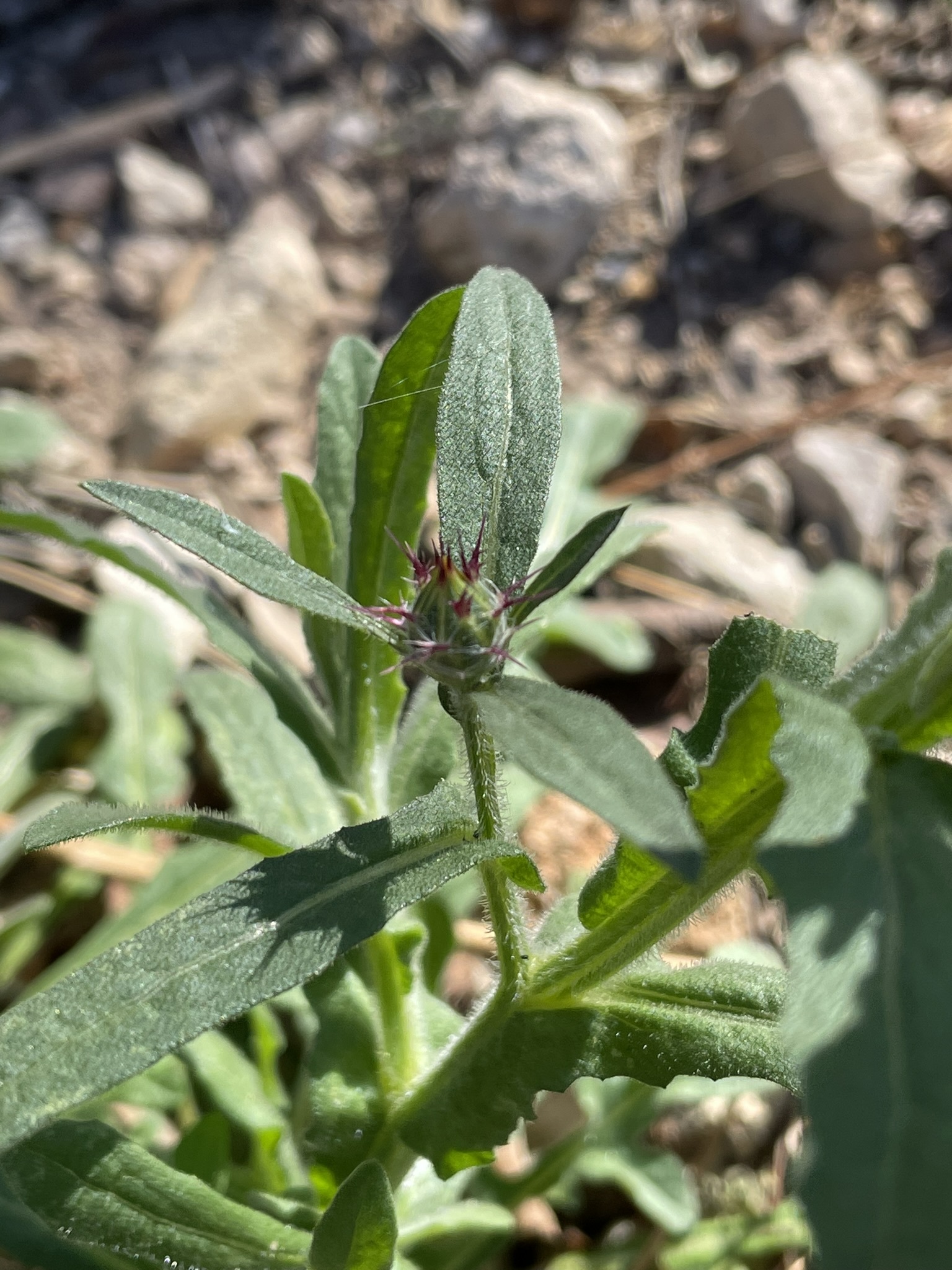
- Leaves: Basal rosette leaves are dark grey-green, thick, oblong, and entire, but become lobed as they mature, and range from 1-6 inches in length. Basal leaves sometimes dry out by the time flowering occurs. Stem leaves are grey-green, linear, 0.5-2 inches long, and alternate up the stem. The margins of stem leaves can be toothed or wavy. Both basal and stem leaves can be covered in cottony white hairs, while the stem leaves have stiff hairs with resinous dots. [3,5]
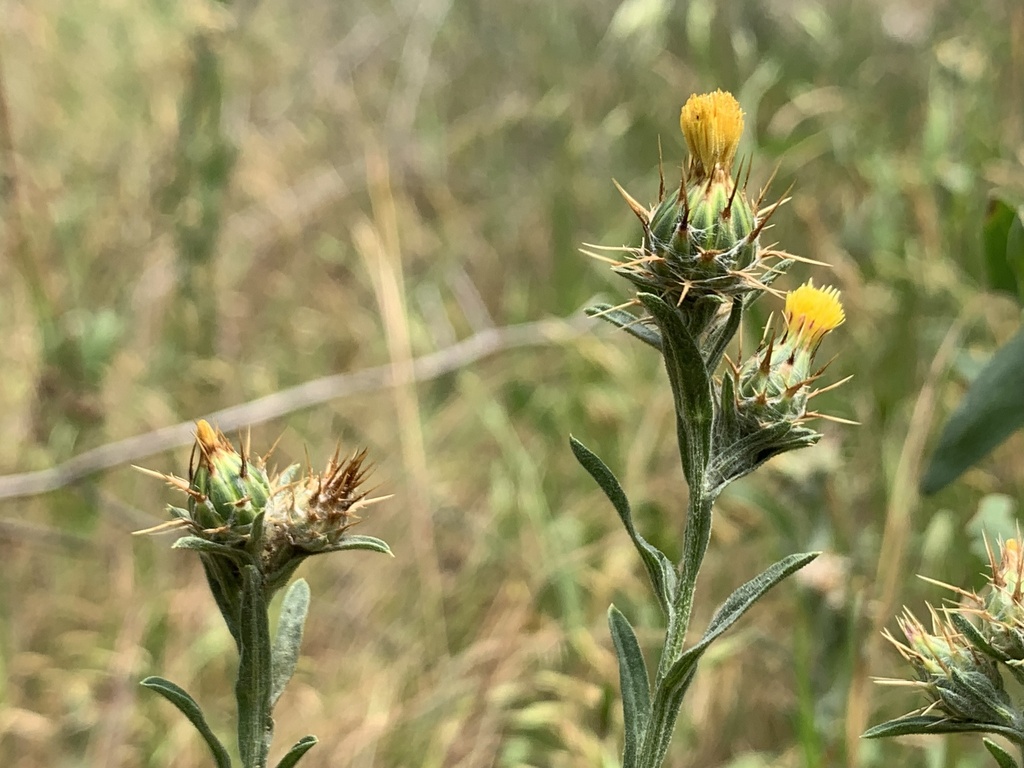
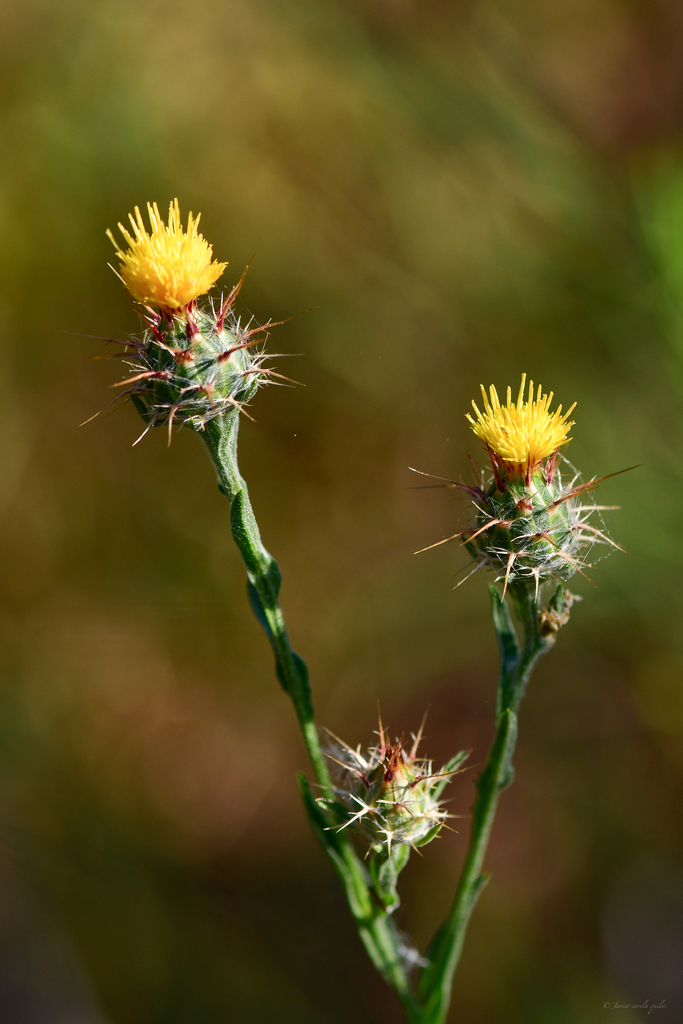
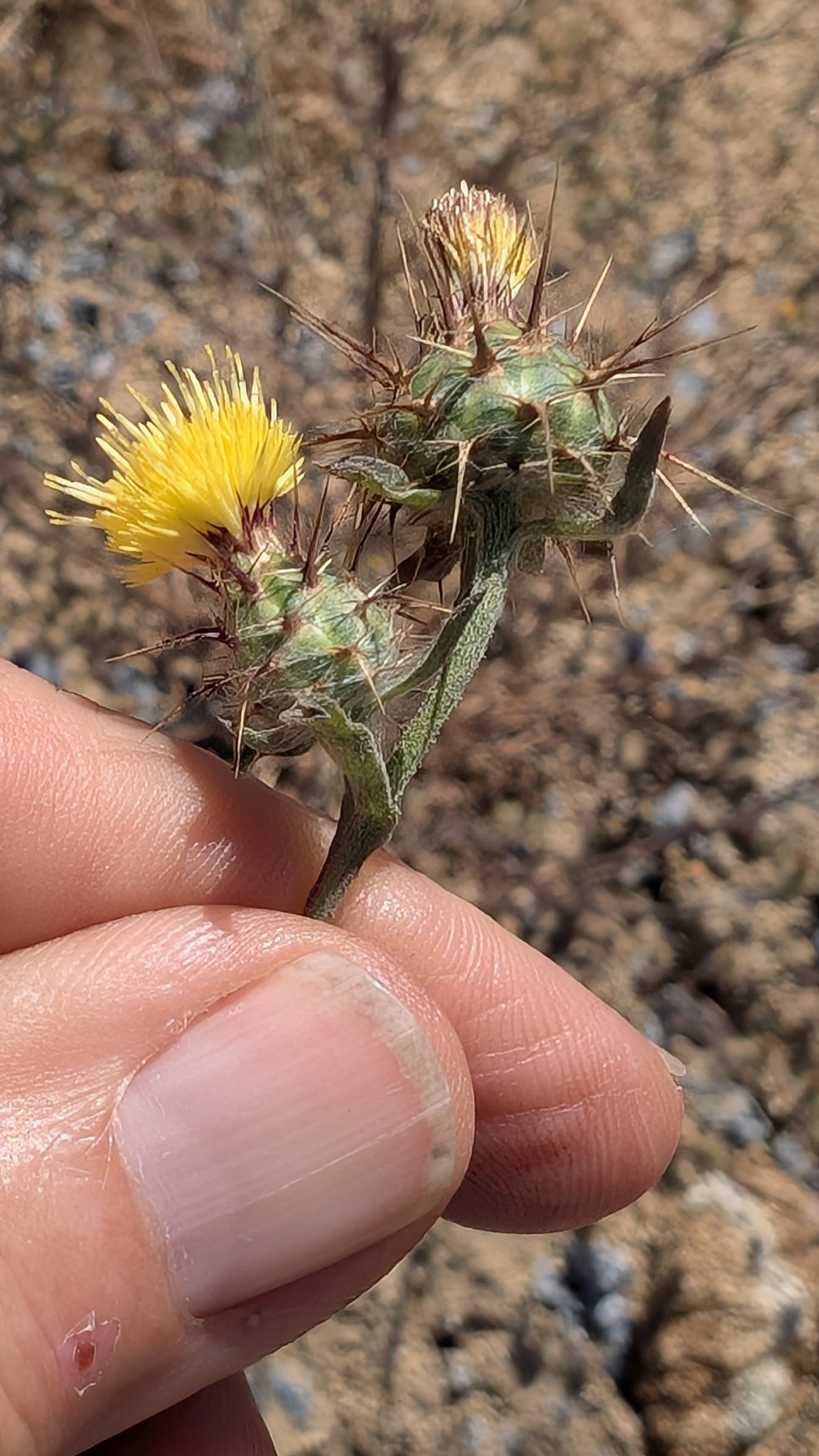
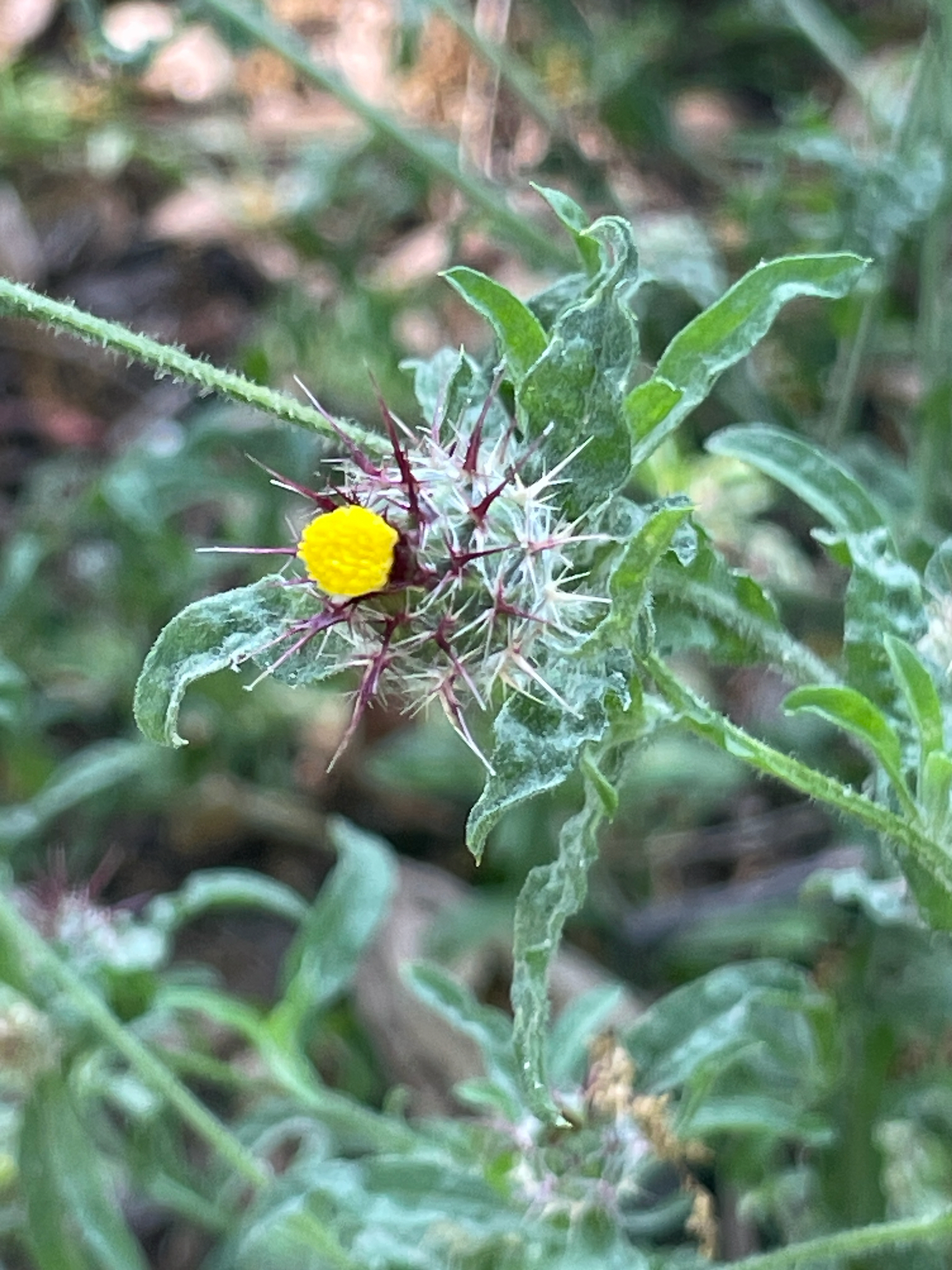
- Flowers: Maltese starthistle can flower from April to June. It has a small, yellow thistle-like flower surrounded by purplish brown spikes. Flowerheads sit on top of stems, are egg-shaped at the base, and are about half an inch long with cottony hairs. Spikes are short, usually about 1/5 to 1/2 inch long. Large plants can produce over 100 flower heads. [3,5]
- Seeds: Maltese starthistle can produce from 1 to over 100 flower heads, and each flower head can have more than 60 seeds per head, depending on growing conditions (about 600 seeds in bigger plants). Seeds are spread shortly after flowering; however, an exact time is unknown. Seeds are tiny (1/10 inch) and have gray-tan stripes. One side of the seed has uneven tan bristles, and the other has a notched scar from where it was attached. While seed viability is unknown, it is theorized to be similar to yellow starthistle, having a longevity of 4-10 years. [3,5]
mutemanifesto, inaturalist.org
Flowerheads sit on top of stems, are egg-shaped at the base, and are about half an inch long with cottony hairs.
marathonvet, inaturalist.org
It starts as a basal rosette of entire, dark grey-green leaves, and becomes deeply lobed as it matures.
Aaron Echols, inaturalist.org
This weed forms a simple taproot through winter and spring.
jessiex47, inaturalist.org
Stem leaves are grey-green, linear, 0.5-2 inches long, and alternate up the stem.
proullard, inaturalist.org
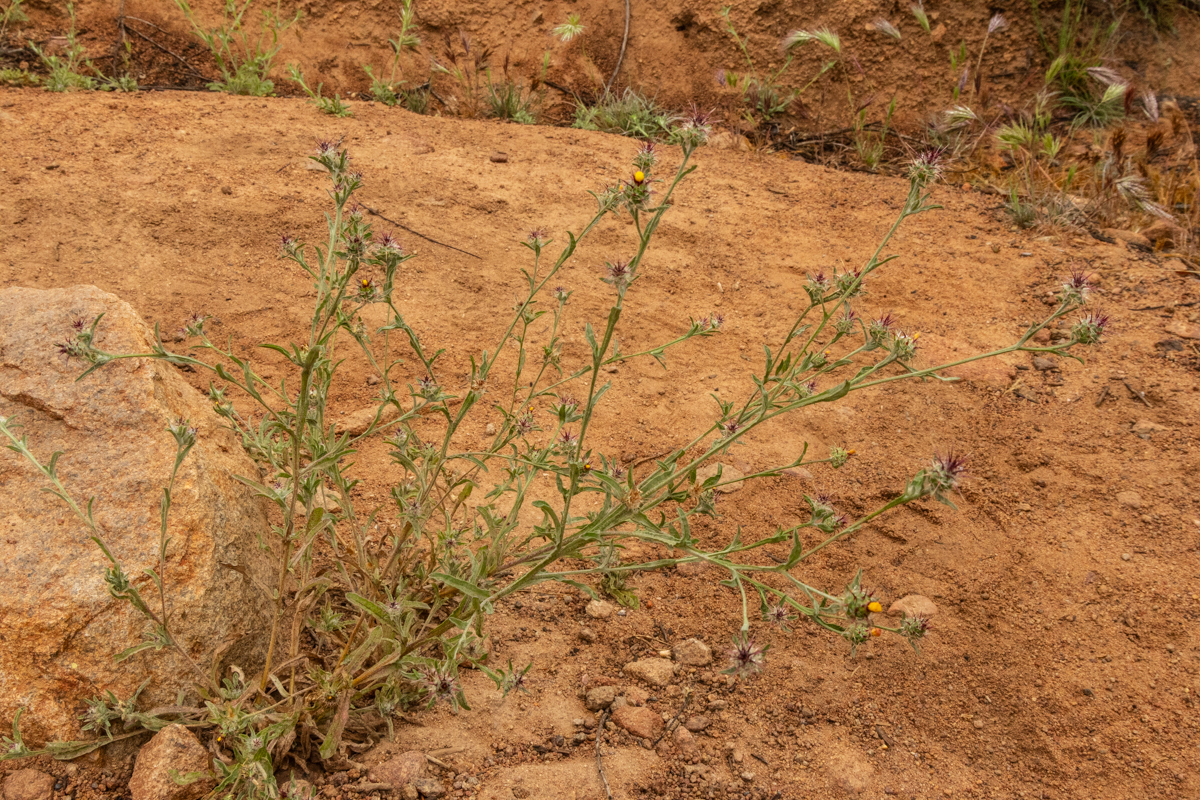
After bolting in spring, they can grow up to 3 feet tall in ideal conditions, but are usually around 2 feet tall.
Alexey P. Seregin, inaturalist.org
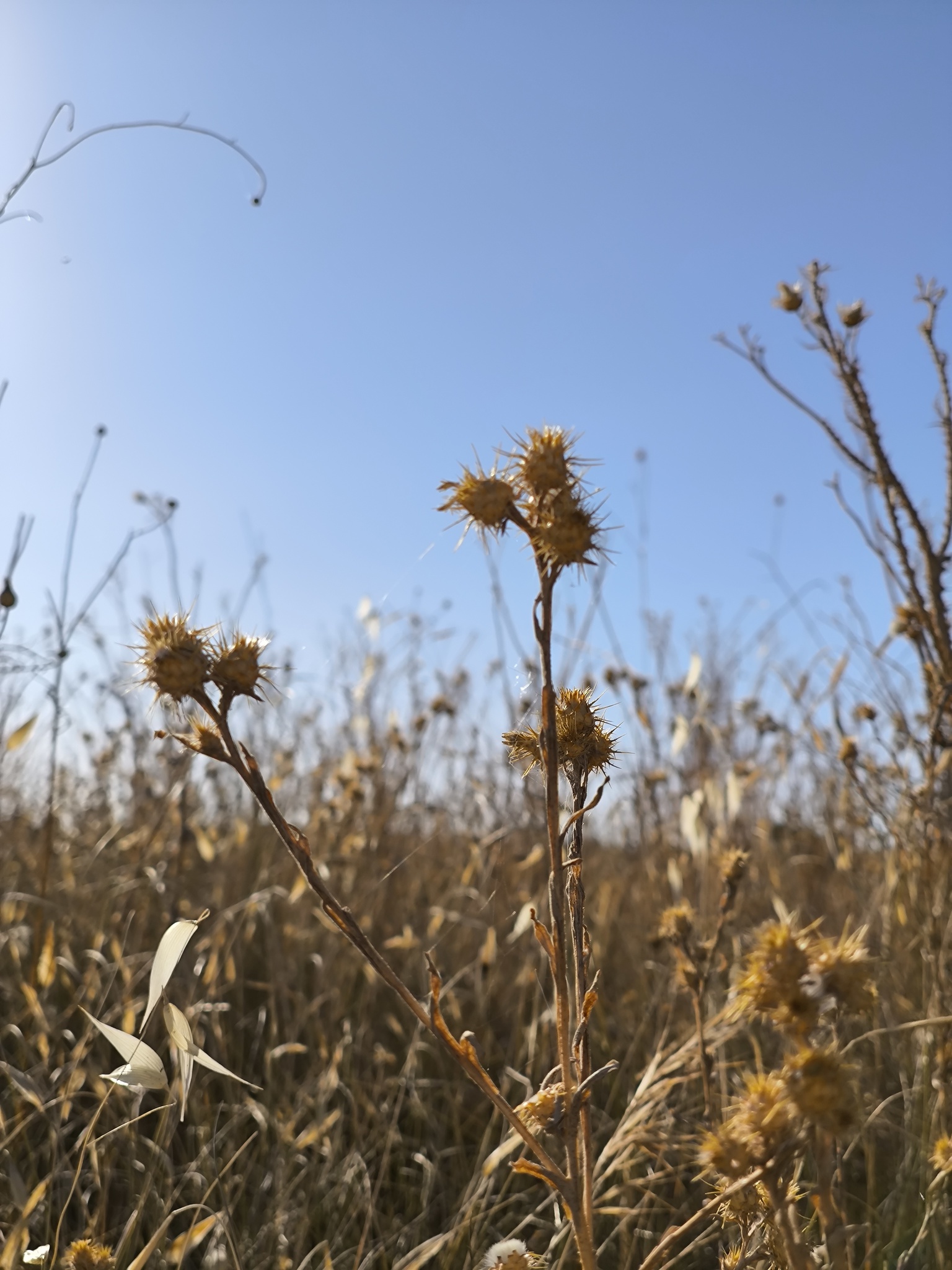
Seeds vary in yield from about 60 to 600 per plant.
3. Infestation Basics
“ Centaurea is one of the most complicated genera because it shows great morphological diversity. Due to this fact, it has taxonomy and hybridization issues”.
– Vonica and Cantor, 2011
Where does it grow, and how does it spread?
Maltese starthistle can be found in open, disturbed sites like grasslands, non-irrigated pastures, roadsides, and cultivated fields. It only spreads by seeds, which can attach to animals, humans, and equipment. Each plant can produce hundreds of seeds. [4]
Maltese starthistle prefers sunny, open areas, but can adapt to grow in partially shaded areas as well. They grow best in warm climates with well-drained soils. Mature plants cannot tolerate flooding or long-term drought. Maltese starthistle seeds can survive drought, flooding, and fires, allowing them to germinate years later when conditions improve. [3]
Maltese starthistle is a winter annual that can germinate from fall through early spring. It forms a rosette of basal leaves and remains that way until bolting, focusing its energy on growing deep taproots throughout the winter. Then, the weed begins to bolt in early spring, quickly producing flowers and dispersing most of its seeds by mid-summer. Maltese starthistle can only create by seed, and its roots cannot grow deeper than 3 feet, making it less invasive than yellow starthistle, but still challenging to manage because it can release hundreds of seeds per plant. [4,5]
This weed relies on insect pollination but can also self-pollinate when insects are unavailable, resulting in reduced diversity and fewer adaptations in this species. Seeds vary in yield from about 60 to 600 per plant. The longevity of Maltese starthistle seeds has not been studied, but it is theorized to be similar to that of the yellow starthistle, of about 3-10 years. [5]
Seeds usually fall near parent plants and compete with themselves for space, but can occasionally be carried by wind or water short distances, and longer distances when attached to animals or human equipment. [3,5]
Key takeaway: While Maltese starthistle usually doesn’t compete with pre-established vegetation, it invades open areas and grows quickly, allowing it to seed and displace desired plants.
Why is it so invasive?
This weed has small, sharp spikes that can harm grazing animals and any human who touches it. The sharp spikes usually deter livestock from grazing in infested fields. It is toxic to horses in large quantities and can quickly displace desired vegetation, with the ability to spread hundreds of seeds per plant.
Maltese starthistle is less invasive than its lookalike, yellow starthistle, but it can still cause damage if left untreated. It typically doesn’t compete with existing vegetation but can quickly take over open areas. Its spikes deter livestock from grazing in infected areas, giving this plant more opportunity to reproduce. When consumed in large quantities, it can also cause chewing disease (equine nigropallidal encephalomalacia), a neurological condition that affects chewing and swallowing in horses. [2,4,5]
This weed is insect-pollinated, produces hundreds of seeds per plant, and usually forms dense stands that displace natural vegetation. [4]
Key takeaway: Maltese starthistle is toxic to horses and can harm humans and other animals due to its sharp spikes. It displaces desired vegetation by forming dense stands and producing several hundred seeds per plant.
Common risk factors for invasion
- Soil disturbance: Maltese starthistle loves to invade disturbed areas, such as construction sites, tilled fields, or overgrazed pastures. This disruption weakens existing vegetation, allowing Maltese starthistle to become established. Minimizing unnecessary soil disturbance can help reduce the risk of invasion.
- Open spaces: While Maltese starthistle has adapted to grow in various areas, it favors open, sunny environments with little to no canopy cover, such as pastures, cultivated fields, and south-facing slopes. These conditions allow Maltese starthistle to establish quickly and outcompete other plants. Maintaining healthy, large-leafed vegetation in these areas can help limit its spread.
- Human activity: Maltese starthistle thrives in areas where soil has been disturbed, such as construction sites, agricultural fields, roadsides, and other places where natural vegetation has been disrupted. These disturbances create openings in the soil, allowing the plant to become established. Additionally, the movement of soil, agricultural products, and equipment can inadvertently introduce weeds to new areas.
- Seed contamination: Seeds often contaminate grain, legume, and other agricultural seed crops. Knowledge of seed origins, cleaning, and the use of planting equipment can help prevent infestations.
- Overgrazing: When livestock are allowed to graze in a single area for too long, they will rip through the existing vegetation and expose the top layer of soil. This creates an opening for Maltese starthistle seeds, but this risk can be mitigated by practices that move cattle around more frequently, such as rotational grazing.
Impacts
Economic
Maltese starthistle has aggressive seed production and vegetative growth. It can reduce the available forage for domestic livestock, as most animals avoid its spikes. This plant is also toxic to horses in large quantities.[4]
Ecosystem and Soil Health
Once established, Maltese starthistle displaces native plants, resulting in a notable loss of floral and faunal biodiversity. When left to invade, it can cause soil erosion and reduced water percolation. [5]
Health and Safety
This weed has small spikes around the base of its flowerhead, which can physically injure children, workers, livestock, and wildlife by causing puncture wounds or infections. It is also poisonous to horses in large quantities. [3]
Livestock
Sheep, goats, cows, and pigs can graze on weeds before they develop spikes, and infested fields are usually avoided, but their spikes can still harm animals. Maltese starthistle contains a toxin that causes a neurological condition known as “chewing disease” in horses. [3]
4. Management Strategies
Not much research has been done on managing Maltese starthistle specifically, but it seems effective to treat it similarly to its more invasive lookalike, yellow starthistle. Preventative measures work best, as this weed rarely competes with established vegetation. However, once an infestation has occurred, effective treatment takes several years. Hand pulling, digging, and mowing are effective at all life stages, but hand pulling is recommended as soon as possible to prevent seed dispersal. Herbicides are also best used before flowering occurs to prevent seed dispersal. Both mechanical and chemical control methods are most effective when used over several years, as seeds remain viable in seed banks for 4-10 years. [4,5]
DO’s
- Keep the desired vegetation healthy and avoid disturbing areas, as this plant can take over open spaces.
- Combine several management methods, including seeding desired plants, herbicides, and mechanical removal.
- Mow, cut, or pull before flowering has occurred, as this prevents seeding.
DON’Ts
- Allow the plant to flower, as it produces hundreds of viable seeds.
- Avoid disturbing areas or allowing livestock to overgraze, as this will enable plants to grow and spread.
- Wait until it is a widespread issue, as this plant is easier to manage in small or individual infestations.
** The following information is provided courtesy of the UC Weed Research and Information Center. nmweeds.org does not endorse the use of any particular product, brand, or application thereof. **
Non‑chemical management of Maltese starthistle focuses on preventing seed production and steadily depleting the seedbank through repeated physical control. Hand‑pulling or digging plants before they flower is effective because the species is an annual with a taproot. Consistent removal over multiple seasons is important, as seeds can persist in soil for years. Mowing can help only if timed before seed heads form, and maintaining dense, competitive vegetation reduces opportunities for new seedlings to establish.
Removal techniques such as hand pulling, mowing, or cultivation, when used to prevent seed production over 2 to 4 years or more (the soil life of the seeds), should reduce or eliminate an infestation. See control techniques for yellow starthistle. These same techniques are expected to be effective on Malta starthistle.
There have been no studies conducted on the use of grazing or prescribed burning for the control of Malta starthistle. It is possible that control with grazing would be similar to that of yellow starthistle.
A small seedheaded-feeding beetle (Lasioderma haemorrhoidale) was unintentionally introduced to California from the Mediterranean region, but has had little effect in controlling Malta starthistle. It is considered a generalist seedhead feeder and is also known to attack yellow starthistle, Sicilian starthistle, blessed milkthistle, and Italian thistle. The false peacock fly and hairy weevil, introduced to control yellow starthistle, will also attack Malta starthistle, but to a lesser degree than yellow starthistle.
- CHEMICAL
- Growth Regulators
- Aromatic Aminoacid Inhibitors
- Branched Chain Aminoacid Inhibitors
- Photosynthetic Inhibitors
The following specific use information is based on published papers and reports by researchers and land managers. Other trade names may be available, and other compounds also are labeled for this weed. Directions for use may vary between brands; see label before use. Herbicides are listed by mode of action and then alphabetically. The order of herbicide listing is not reflective of the order of efficacy or preference.
|
2,4-D Several names |
Rate: 1 to 1.5 pt product/acre (0.48 to 0.72 lb a.e./acre) for small rosettes, 2 to 4 pt product/acre (0.95 to 1.9 lb a.e./acre) for larger plants up to bolting Timing: Postemergence from rosette to the beginning of bolting, but before flowering. Remarks: 2,4-D controls larger plants well, but is not considered as effective as other growth regulator herbicides for season-long control. It is broadleaf-selective and has no soil activity. Do not apply ester formulation when outside temperatures exceed 80°F. Amine forms are as effective as ester forms for small rosettes, and amine forms reduce the chance of off-target movement. |
|
Aminocyclopyrachlor + chlorsulfuron Perspective |
Rate: 3 to 5 oz product (Perspective)/acre Timing: Postemergence and preemergence. Postemergence applications are most effective when applied to plants from the seedling to the mid-rosette stage. Remarks: Aminocyclopyrachlor gives control of yellow starthistle similar to aminopyralid. Perspective provides broad-spectrum control of many broadleaf species. Although generally safe to grasses, it may suppress or injure certain annual and perennial grass species. Do not treat in the root zone of desirable trees and shrubs. Do not apply more than 11 oz product/acre per year. At this high rate, cool-season grasses will be damaged, including bluebunch wheatgrass. Not yet labeled for grazing lands. Add an adjuvant to the spray solution. This product is not approved for use in California and some counties of Colorado (San Luis Valley). |
|
Aminopyralid Milestone
|
Rate: 4 to 5 oz product/acre (1 to 1.25 oz a.e./acre). Use higher rates when weeds are larger. Timing: Postemergence and preemergence. Postemergence applications are most effective when applied to plants from the seedling to the mid-rosette stage. Remarks: Aminopyralid is one of the most effective herbicides for the control of all starthistles. It is safe on grasses, although preemergence application at high rates can greatly suppress invasive annual grasses, such as medusahead. Aminopyralid has a longer residual and higher activity than clopyralid. Other members of the Asteraceae and Fabaceae are very sensitive to aminopyralid. For postemergence applications, a non-ionic surfactant (0.25 to 0.5% v/v spray solution) enhances control under adverse environmental conditions; however, this is not normally necessary. Other premix formulations of aminopyralid can also be used for Malta starthistle control. These include Chaparral (aminopyralid + metsulfuron; 1.5 to 2 oz product/acre), Opensight (aminopyralid + metsulfuron; 1.5 to 2 oz product/acre), and Forefront HL (aminopyralid + 2,4-D; 1.5 to 2.1 pt product/acre), all applied at the rosette to bolting stages. |
|
Clopyralid Transline
|
Rate: 0.25 to 0.67 pt product/acre (1.5 to 4 oz a.e./acre). Seedlings and rosettes can be treated at the lower rate, but bolted plants should be treated at higher rates. Timing: Postemergence and preemergence. For postemergence application, apply to plants from seedling to mid-bolting stage. However, optimal timing is at the later rosette stages, but before bolting. Remarks: Clopyralid gives excellent control of all starthistles. While it is very safe on grasses, it will injure many members of the Asteraceae, particularly thistles, and can also injure legumes, including clovers. Most other broadleaf species and all grasses are not injured. When clopyralid is used to control seedlings, a surfactant is not necessary. However, when treating older plants or plants exposed to moderate levels of drought stress, surfactants can enhance the activity of the herbicide |
|
Dicamba Banvel, Clarity |
Rate: 0.5 pt product/acre (0.25 lb a.e./acre) for seedlings, 1 to 1.5 pt product/acre (0.5 to 0.75 lb a.e./acre) for larger plants up to bolting. Timing: Postemergence to plants from rosette to beginning of bolting. Remarks: Dicamba is a broadleaf-selective herbicide often combined with other active ingredients. It is not typically used alone to control any starthistle species. |
|
Picloram Tordon 22K
|
Rate: 0.5 pt product/acre (0.25 lb a.e./acre) for seedlings, 1 to 1.5 pt product/acre (0.5 to 0.75 lb a.e./acre) for larger plants up to bolting. Timing: Postemergence to plants from rosette to the beginning of bolting. Remarks: Dicamba is a broadleaf-selective herbicide often combined with other active ingredients. It is not typically used alone to control any starthistle species. |
|
Triclopyr Garlon 3A, Garlon 4 Ultra |
Rate: 1 pt Garlon 4 Ultra or 1.33 pt Garlon 3A/acre (0.5 lb a.e./acre) for seedlings, up to 3 pt Garlon 4 Ultra or 4 pt Garlon 3A/acre (1.5 lb a.e./acre) for larger plants. Timing: Postemergence from seedling to bolting stage. Remarks: Triclopyr has little to no residual activity. It is broadleaf-selective and typically does not harm grasses. Formulated as both an amine and an ester. Garlon 4 Ultra is formulated as a low-volatile ester. However, in warm temperatures, spraying onto hard surfaces such as rocks or pavement can increase the risk of volatilization and off-target damage. |
|
Glyphosate Roundup, Accord XRT II, and others |
Rate: Broadcast foliar treatment: 1.33 to 2.67 qt product (Roundup ProMax)/acre (1.5 to 3 lb a.e./acre). Spot treatment: 1% to 2% v/v solution Timing: Postemergence from bolting to the beginning of flowering. Remarks: Glyphosate is the most effective herbicide for late-season control. Good coverage, clean water, and rapidly growing Malta starthistle plants are all essential for adequate control. It has no soil activity. Glyphosate is nonselective. To achieve selectivity, it can be applied using a wiper or spot treatment to control current-year plants. In late-season treatments, a surfactant should be added to the herbicide mixture. |
|
Chlorsulfuron Telar |
Rate: 1.33 to 2.6 oz product/acre (1 to 1.95 oz a.i./acre) Timing: Preemergence activity only. Chlorsulfuron does not have postemergence activity on yellow or Malta starthistle and must be used in combination with 2,4-D, dicamba, or triclopyr to provide effective control. Remarks: Chlorsulfuron has mixed selectivity on both broadleaf and grass species, but is generally safe on grasses. It has a fairly long soil residual. The herbicide solution requires constant agitation during application. |
|
Imazapyr Arsenal, Habitat, Stalker, Chopper, Polaris |
Not often used for Malta starthistle control, but has been shown to be somewhat effective at 3 to 4 pt product/acre. It has preemergence and some postemergence activity, and has a long soil residual. |
|
Sulfometuron Oust and others |
Not often used for Malta starthistle control, but has been shown to be somewhat effective at 1 to 2 oz product/acre. It has preemergence activity only and a long soil residual. |
|
Hexazinone Velpar L |
Not often used for Malta starthistle control, but has been shown to be somewhat effective at 1 to 2.5 gal product/acre (2 to 5 lb a.i./acre). It has preemergence activity only and a long soil residual. High rates of hexazinone can create bare ground, so only use high rates in spot treatments. |
6. References
Citations
[1] “Malta Star Thistle – Centaurea melitensis,” www.sdcwma.org. Available: https://www.sdcwma.org/species/maltastarthistle.php
[2] “IPCW Plant Report – California Invasive Plant Council,” Cal-ipc.org, 2025. Available: https://www.cal-ipc.org/resources/library/publications/ipcw/report27/ . Accessed: Jul. 09, 2025
[3] D. Roche, “Centaurea melitensis (Maltese starthistle),” CABI Compendium, Nov. 2009, doi: https://doi.org/10.1079/cabicompendium.109133
[4] USDA. Forest Service, “Field Guide Agriculture Forest for Managing Service Southwestern Region,” 2010. Available: https://txmn.org/lindheimer/files/2012/05/managing_starthistle.pdf.
[5] WSNWCB, “Written Findings of the Washington State Noxious Weed Control Board.” Available: https://www.nwcb.wa.gov/pdfs/Malta-starthistle-draft-WF.pdf.
[6] R. Ayad et al., “Phytochemical and biological activity of Algerian Centaurea melitensis,” International Journal of Medicinal and Aromatic Plants, vol. 2, no. 1, pp. 151–154, 2012.
[7] G. Vonica and M. Cantor, “Problems and Conflicts in the Identification of Centaurea Species,” Brukenthal. Acta Musei, VI. 3, 2011.
Francisco Javier Carela Quilez, inaturalist.org
Mary Kay Van Sistine, inaturalist.org
Fun Facts
In traditional medicine, the Centaurea species is used for a wide range of therapeutic reasons. Maltese starthistle was traditionally used for treating hypoglycemia. [6]
Vince Scheidt, inaturalist.org
Jiovanny Celis, inaturalist.org
Fun Facts
Because of the wide medicinal benefits of the Centaurea species, Centaurea melitensis has been studied for its antioxidant properties and continues to be investigated for the development of new medicines. [6]
txnaturewatch, inaturalist.org
beth, inaturalist.org
Fun Facts
In its natural habitat, the Centaurea species often faces hybridization, which has caused taxonomic issues and misidentification for several years. [7]
Lori Reznick, inaturalist.org
Jocele, inaturalist.org
Matt Dickson, inaturalist.org
Matt Dickson, inaturalist.org