

Spiny Cocklebur
Xanthium spinosum
Children & Pets
This plant may pose a particular risk to unsupervised children and animals due to its toxicity or potential for injury.
Class B
Llimited to portions of the state. In areas with severe infestations, management should be designed to contain the infestation and stop any further spread.
Toxic to Horses
This plant has been documented to sicken or injure horses.
Livestock Hazard
This plant presents a threat to the health and/or quality of livestock.
Agricultural Threat
This plant threatens our state’s food security and economy by reducing agriculture yields and/or degrading soil resources.
QUICK FACTS
- Spiny cocklebur is an herbaceous annual that can grow up to 3 feet tall, has dark green leaves that are lanceolate and three-lobed, yellow spikes at leaf axils, and burs that contain two seeds each.
- Native to South America, it has only one known medicinal use: as a diuretic. This weed is most commonly spread by clinging to animal fur or hay bales, but burs can also spread through human movement, equipment, and water.
- This plant has adapted to grow under various conditions. It invades disturbed areas and affects crop growth, and can poison animals.
1. Overview
A poisonous, worldwide nuisance.
Spiny Cocklebur is an herbaceous annual that is invasive in several countries worldwide. It is considered a noxious weed in most U.S. states, including New Mexico. It can adapt to grow under various climatic conditions and thrives in disturbed soils. Its allelopathic effects affect the growth of plants such as soybeans, tomatoes, cotton, and corn. [4]
History of Spiny Cocklebur
Spiny cocklebur is native to South America and is hypothesized to originate in Chile, but its exact native range remains unknown. It was used medicinally as a diuretic in its native habitat. It likely spread to the U.S. by burrs attached to livestock. It is also possible that it was reintroduced to the U.S. following European colonization, but its subsequent spread is difficult to trace. [4,5]
Spiny cocklebur is widespread in warm regions worldwide. It has been introduced to 39 countries and invades a variety of habitats, including pastures, roadsides, floodplains, ditches, and abandoned areas. In the U.S., it is considered a noxious weed in 46 states, including New Mexico. [4]
2. ID Guide
What does it look like?
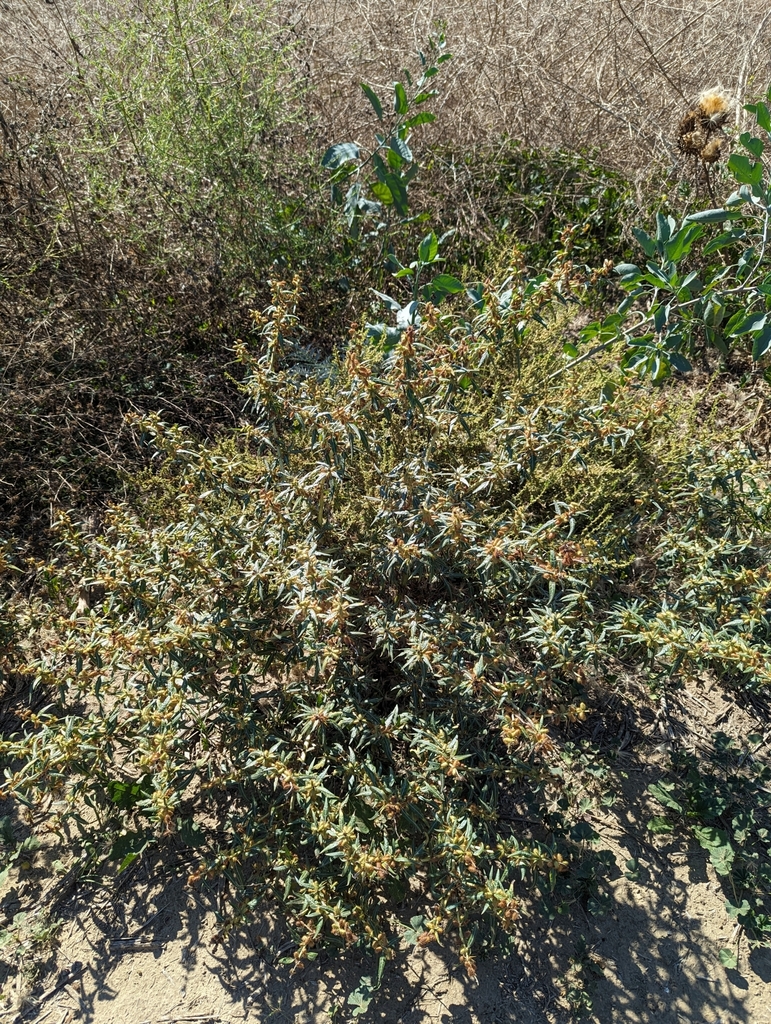
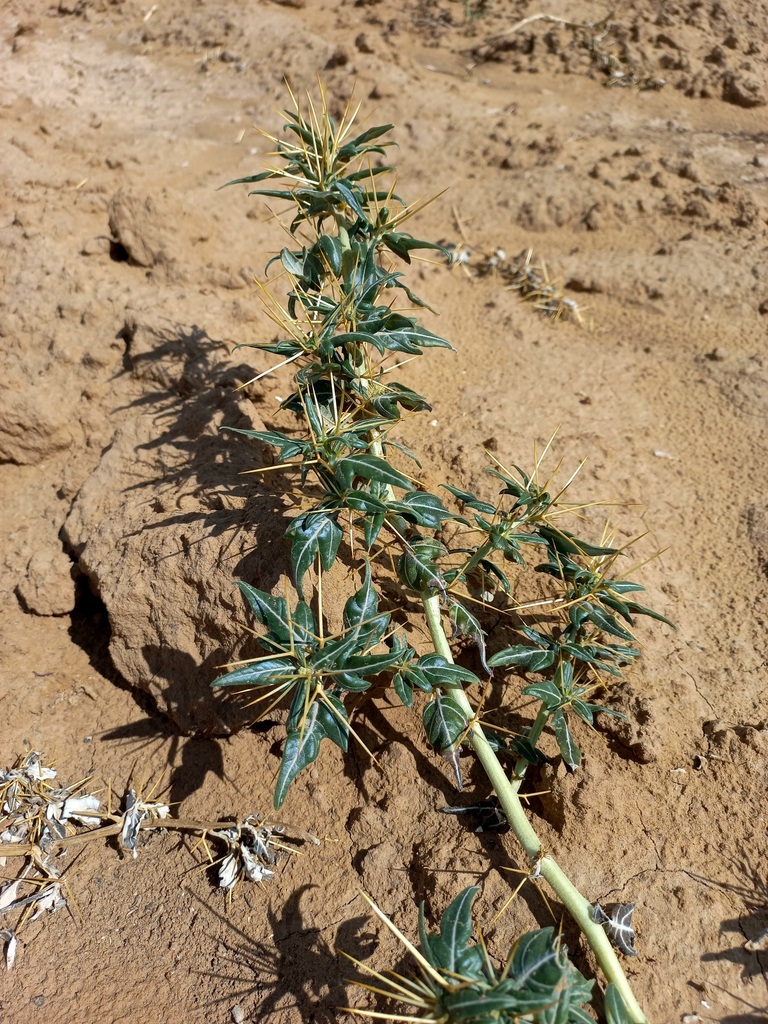
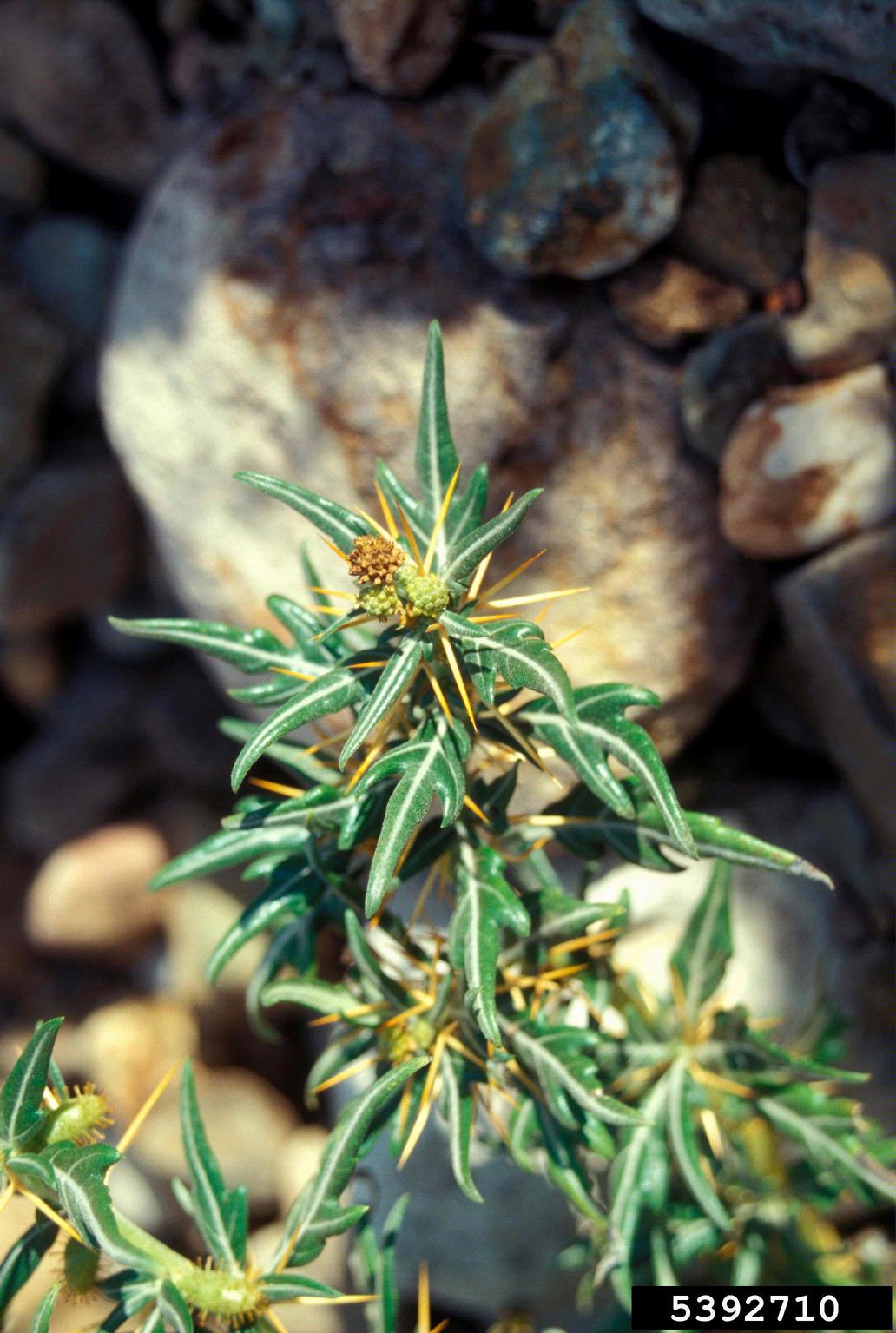
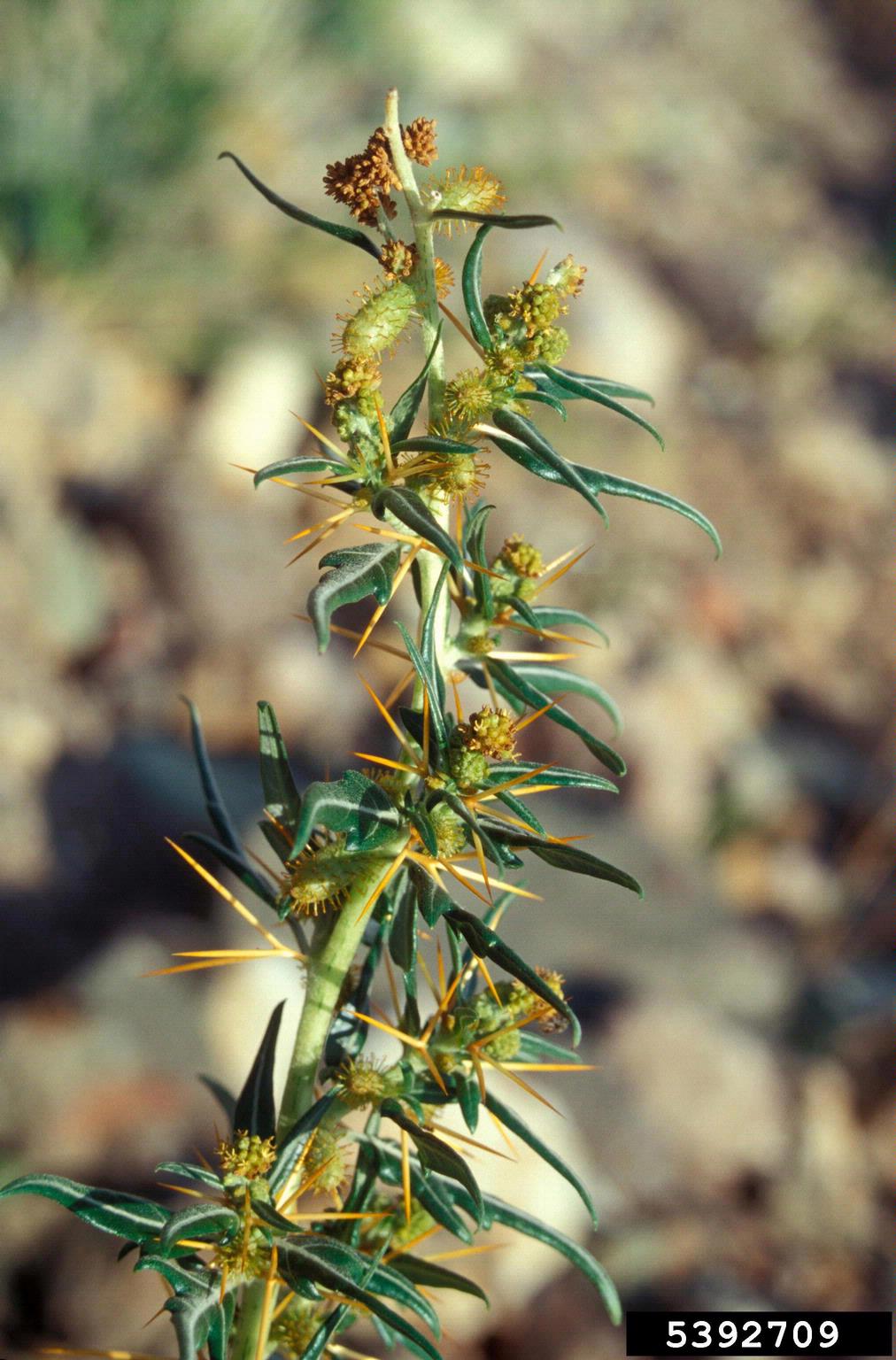
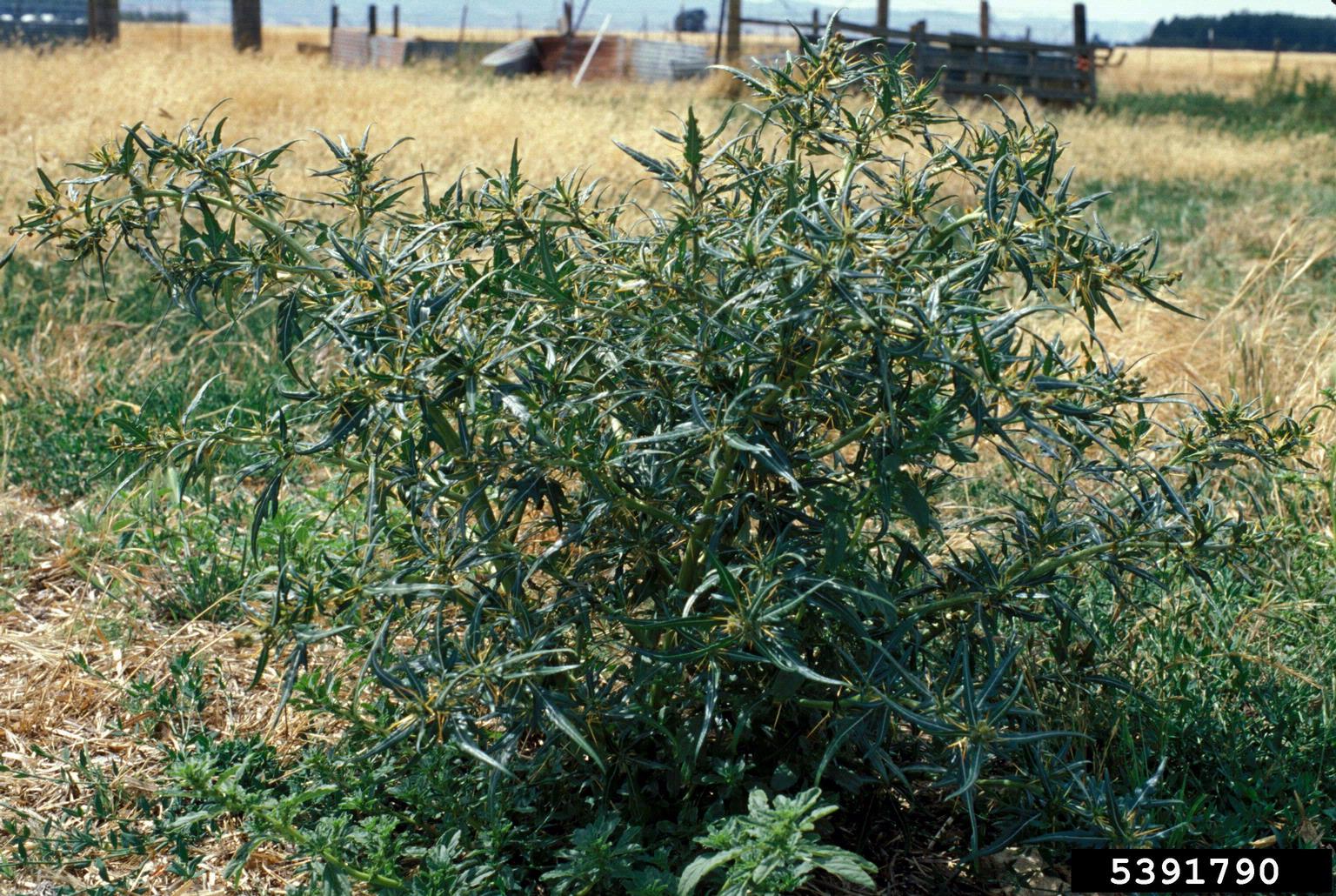
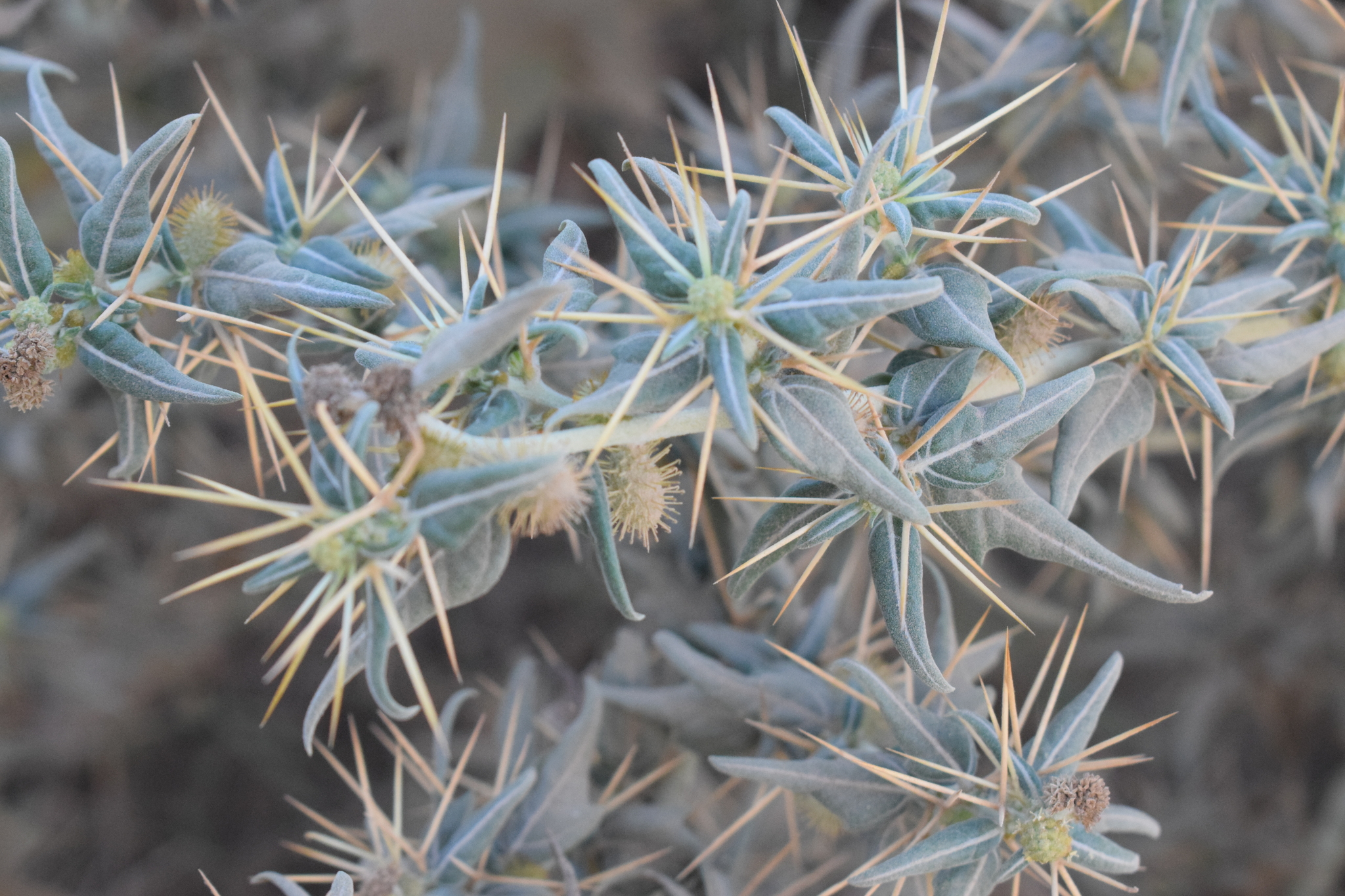
Spiny cocklebur is an herbaceous annual that can grow in a variety of habitats. It grows up to 3 feet tall, has yellow spikes out of leaf axils, and dark green leaves that have 3 lobes. Its flowers are small and green, and can develop into burs with 2 seeds each. Burs are brown and have small hooks that adhere to several materials, including animal fur, hair, wool, and clothing. Spiny cocklebur may be confused with common cocklebur (X.strumarium), but can be differentiated by its narrow leaves, spikes at the leaf base, and oval burs with hooked thorns. [4]
Having trouble identifying a weed?
Contact your local conservation district or county extension agent.
Key Features
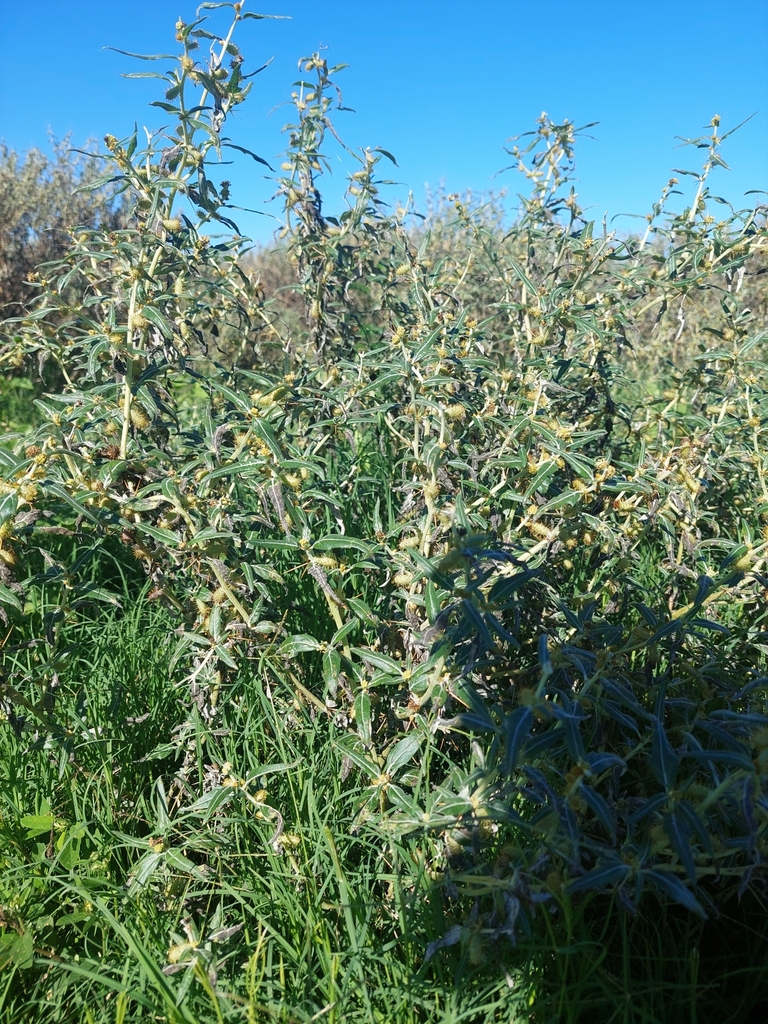
- Plant: Spiny cocklebur grows up to 3 feet tall. Its stem is yellow to brown, tough, hairy, and branched. Leaves are dark green, 3-lobed, and up to 3 inches long, with yellow spikes at leaf axils.[2,7]
- Roots: Fibrous or branched taproots; not considered important for management or identification. [2]
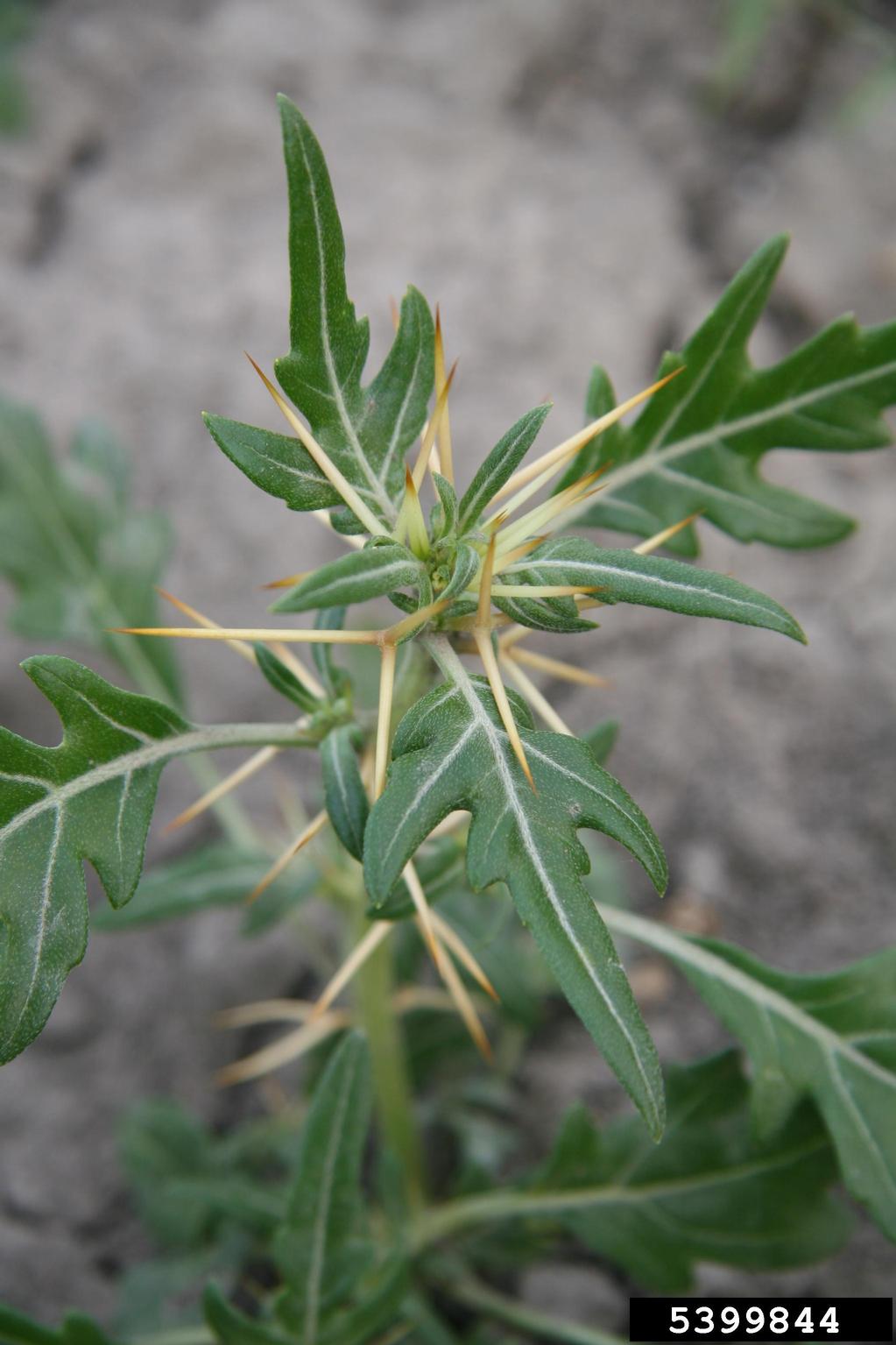
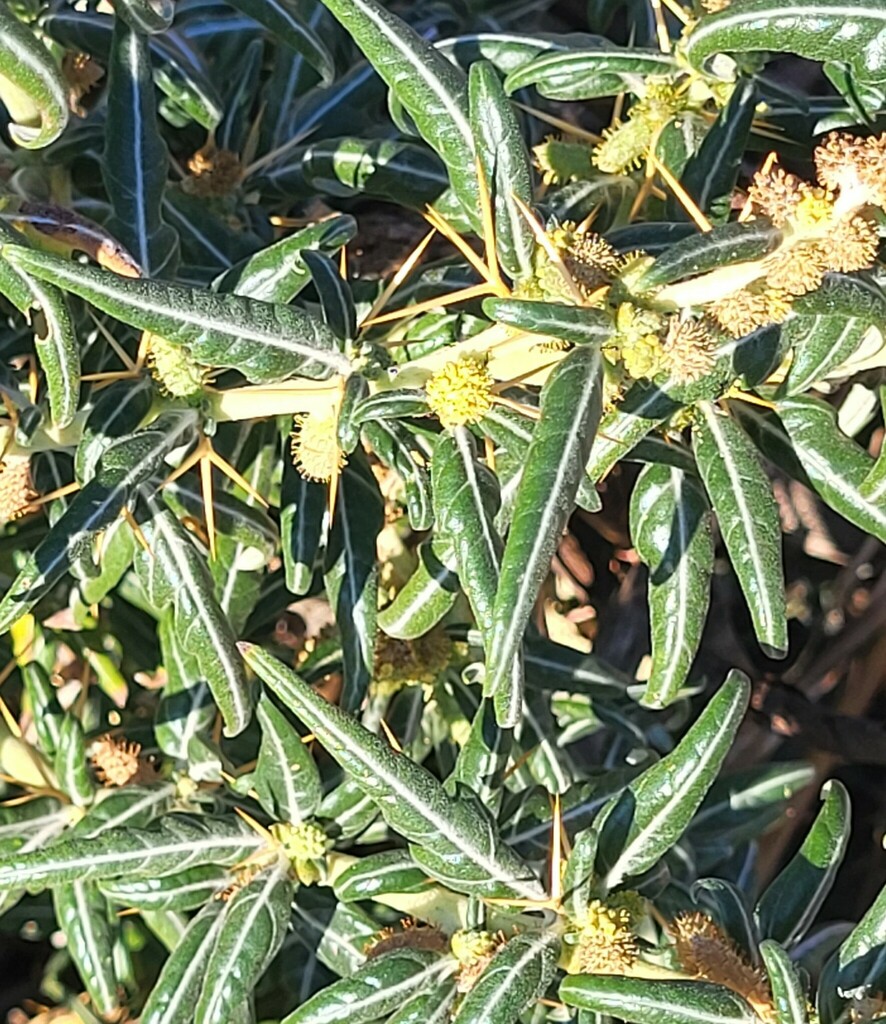
- Leaves: The leaves are dark, shiny, and hairy on the top side of the leaf, and a paler, downy color on the bottom of the leaf. They can grow up to 3 inches long and 1 inch wide. Leaves are lanceolate, entire, and usually three-lobed. The bases of the leaves have yellow spikes approximately 1 inch long. [4]
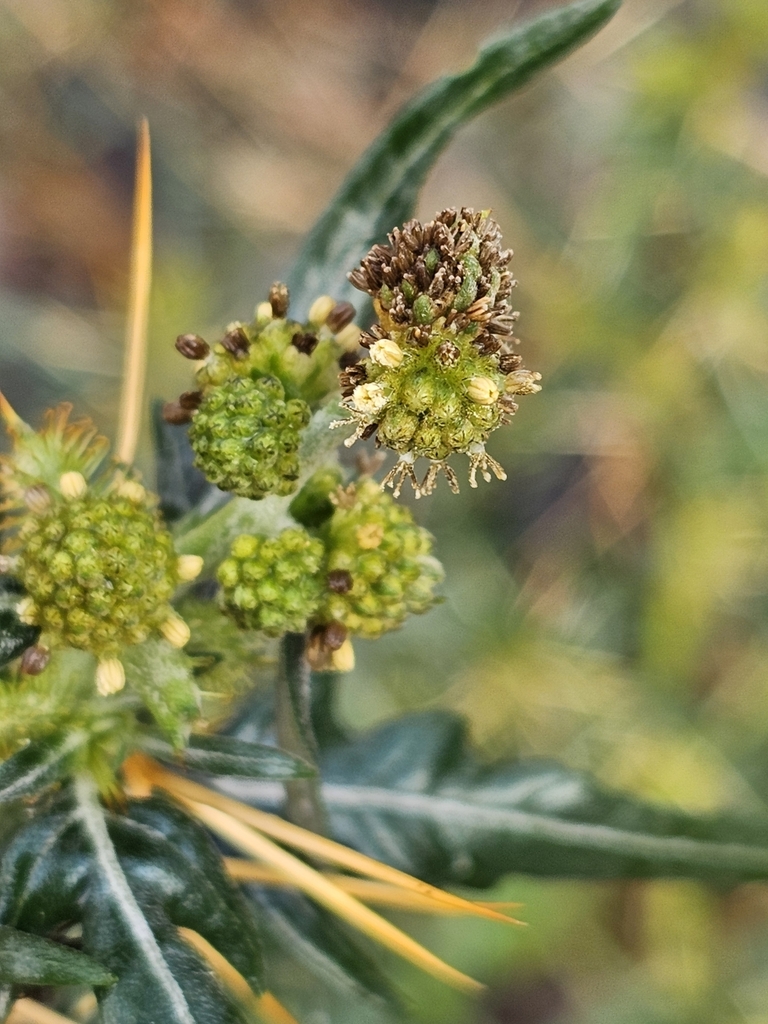
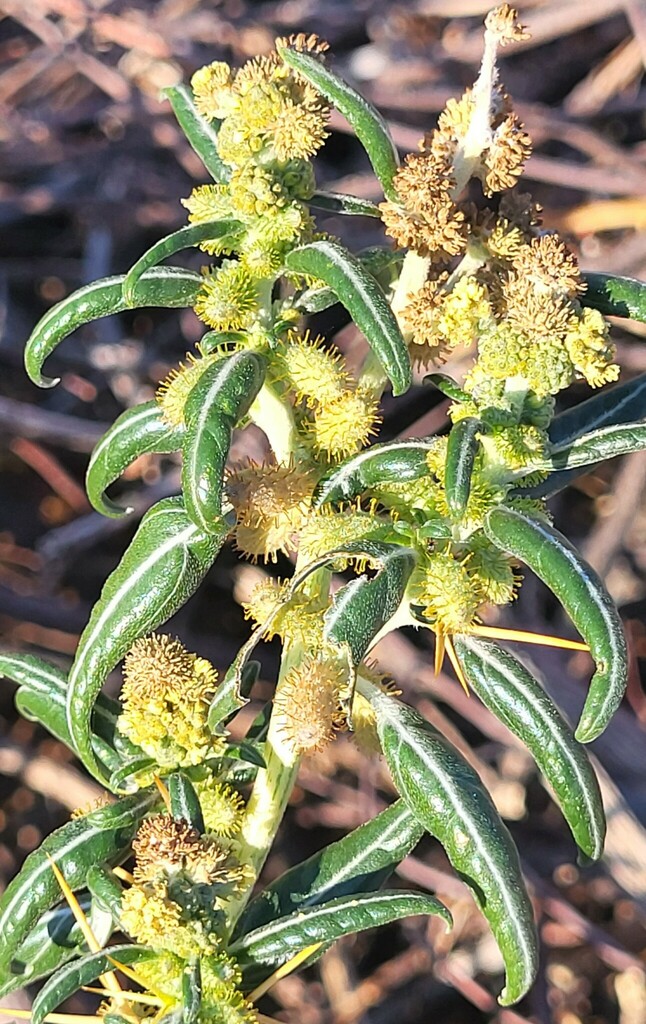
- Flowers: Spiny cocklebur has small, inconspicuous flowers. Male flowers grow on top of stems. They are small, green, and develop in clusters. Female flower heads grow on leaf axils either singly or in small clusters. Female flower heads have 2 flowers and harden into prickly burs that contain seeds. [7]
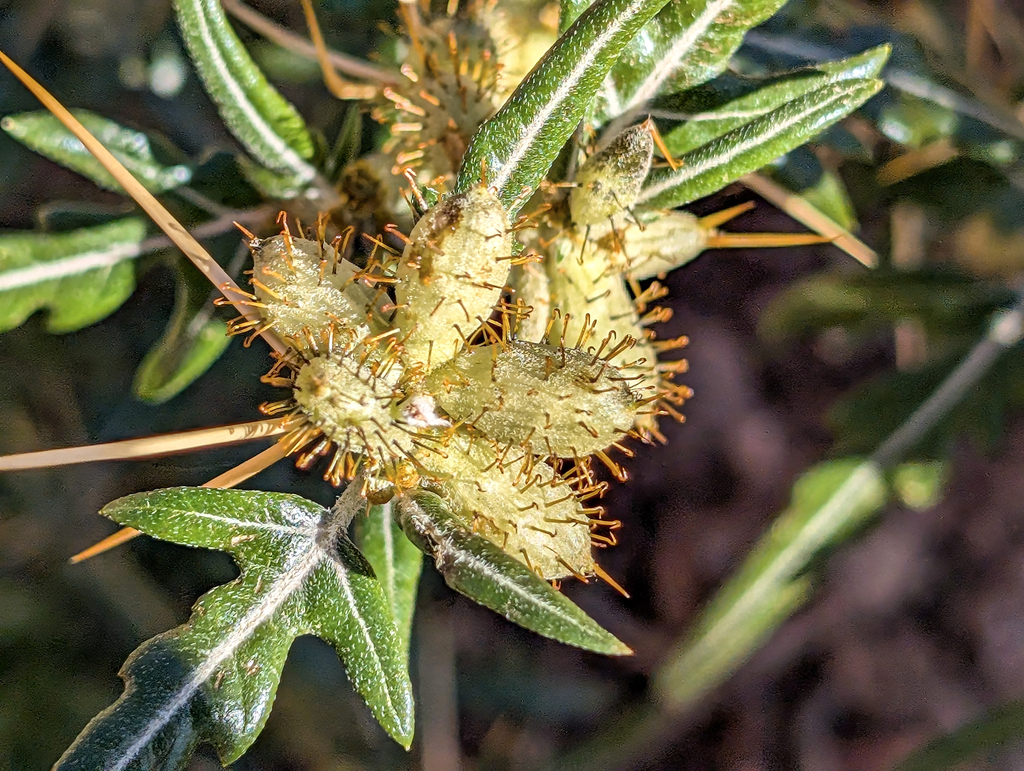
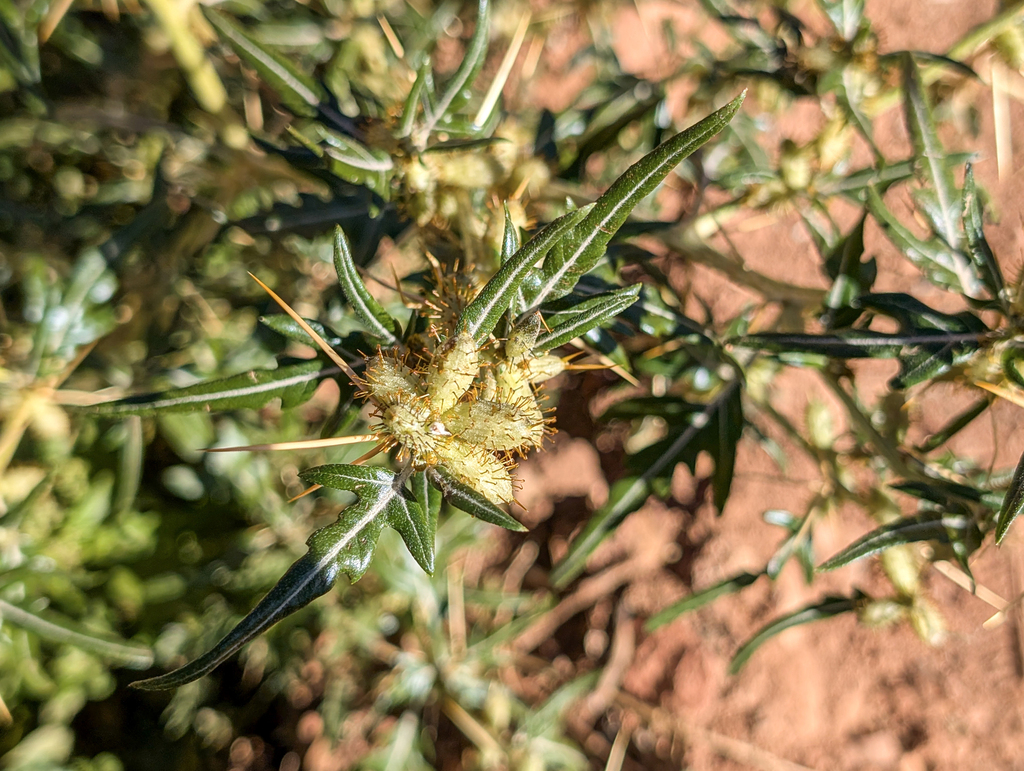
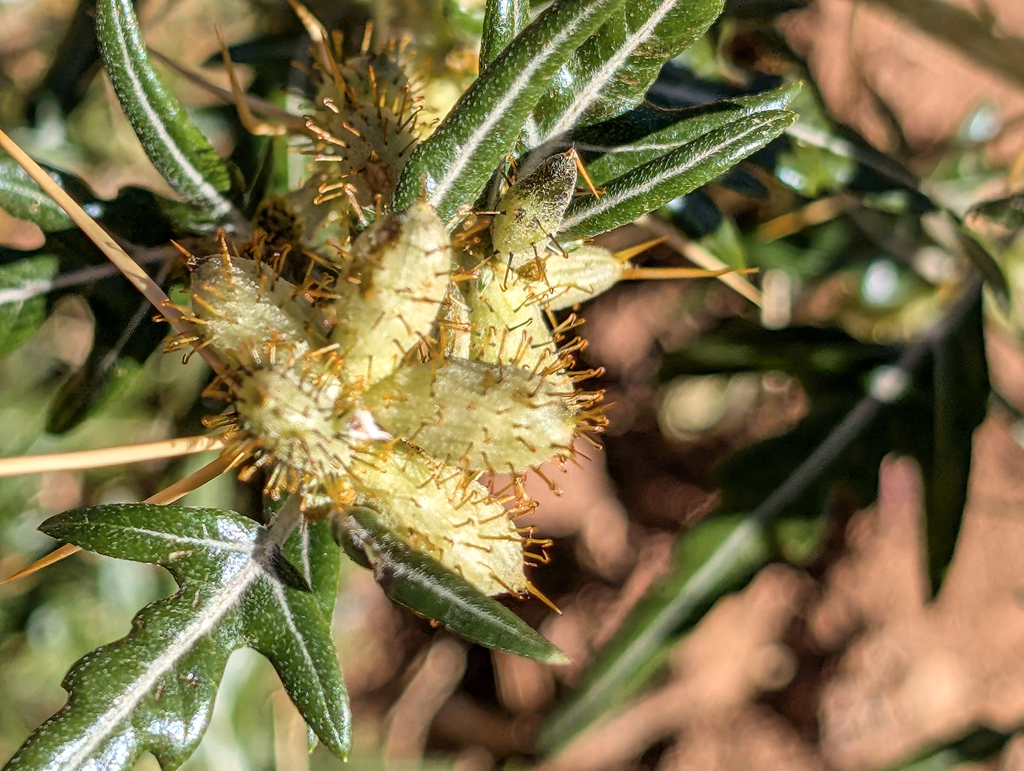
- Seeds: Seeds are found in the fruit, which is a brown egg-shaped burr about 1/2 inch long and 1/3 inch wide. Burs are smooth and covered in spines with hooked ends. There are two seeds in each burr, each flat, 3/8 inch long, and brown. [1,5]
Markus Ackermann, inaturalist.org
Spiny cocklebur has small, inconspicuous flowers. They are small, green, and develop in clusters.
Joseph M. DiTomaso, University of California – Davis, Bugwood.org
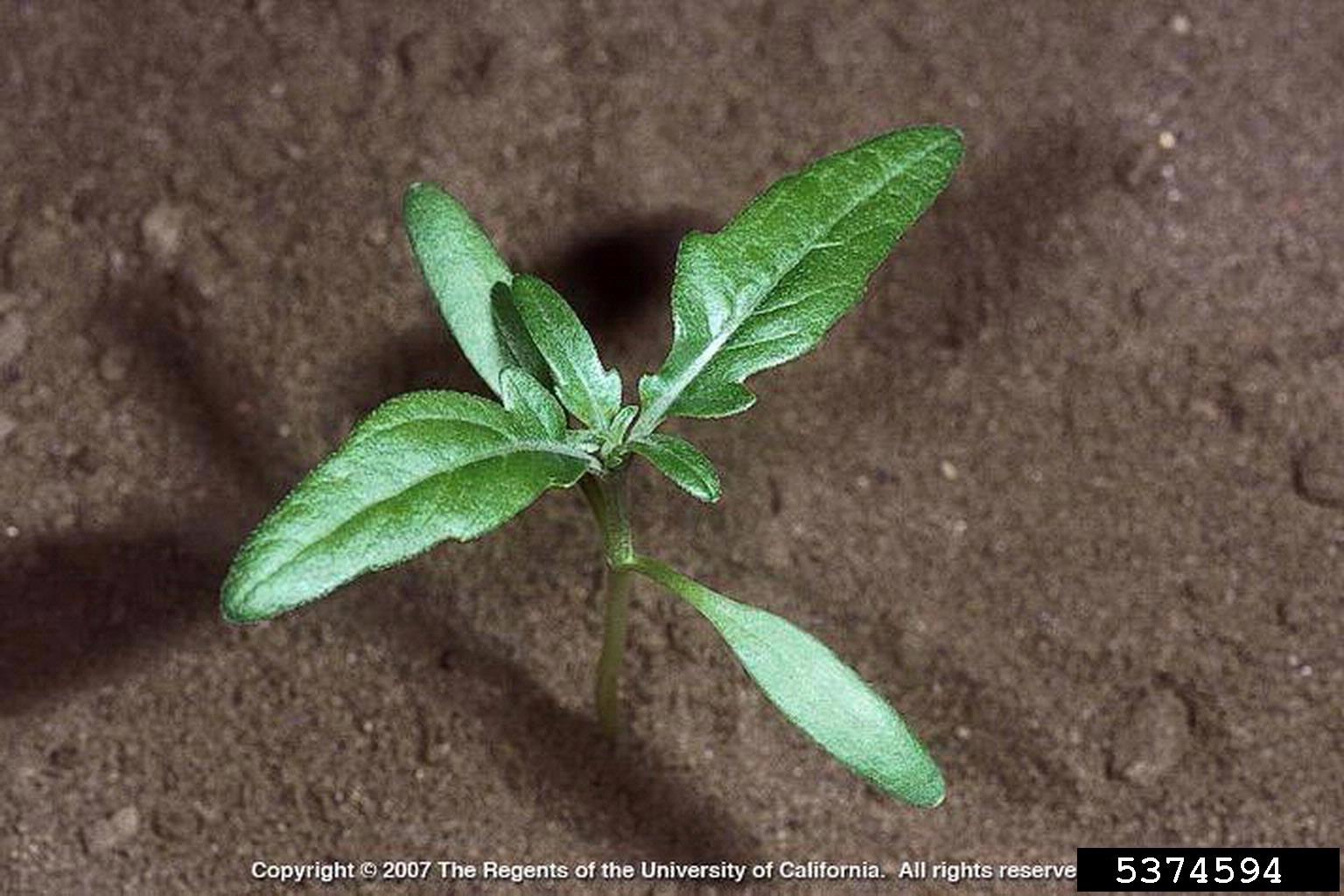
Spiny cocklebur can germinate any time between early spring and summer after rain.
Philip Steiner, Inaturalist.org
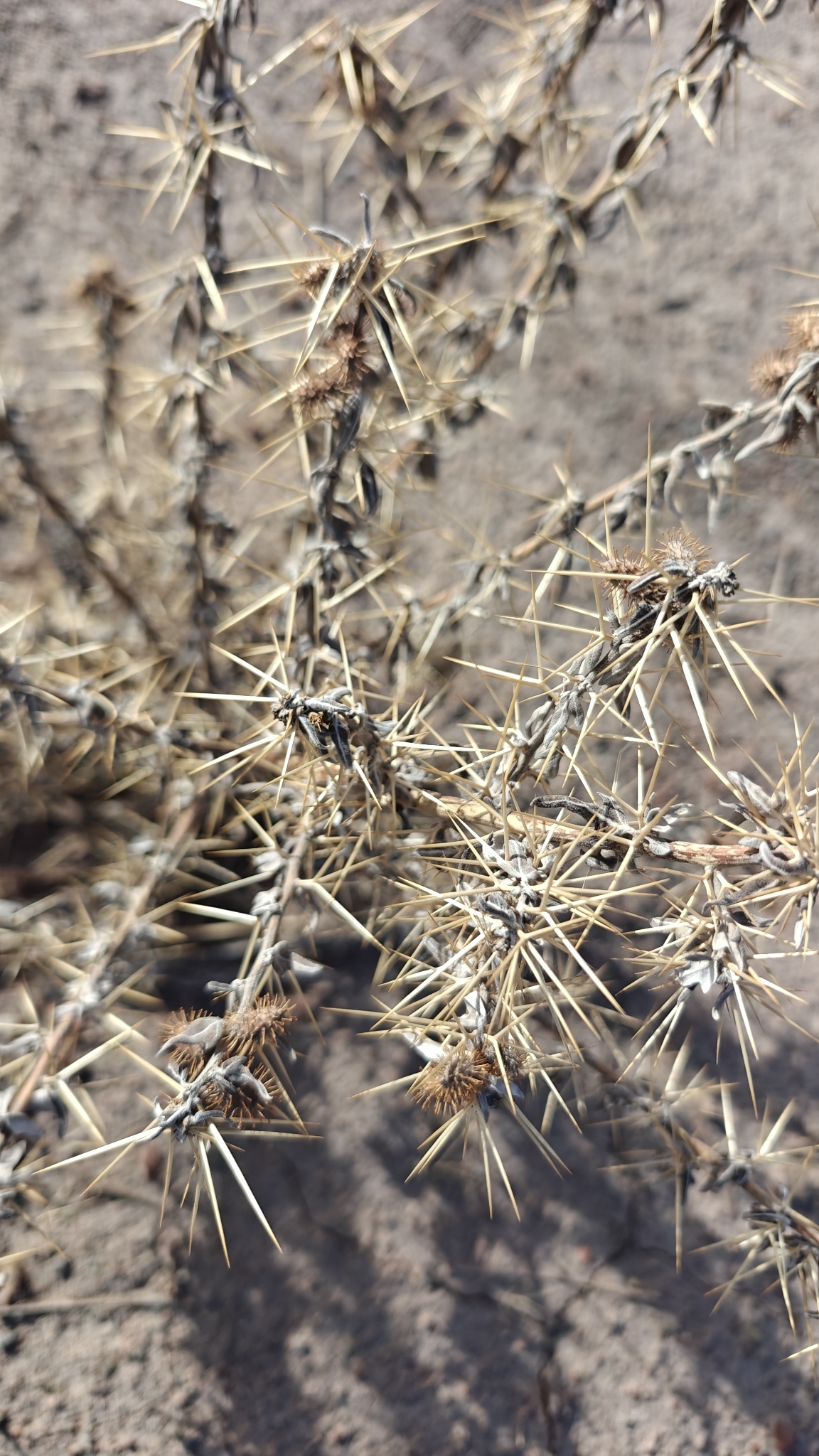
Most plants die in late fall or early winter due to frost.
Robert Vidéki, Doronicum Kft., Bugwood.org
The leaves are dark, shiny, and hairy on the top side of the leaf, and a paler, downy color on the bottom of the leaf.
Diane Rose, inaturalist.org
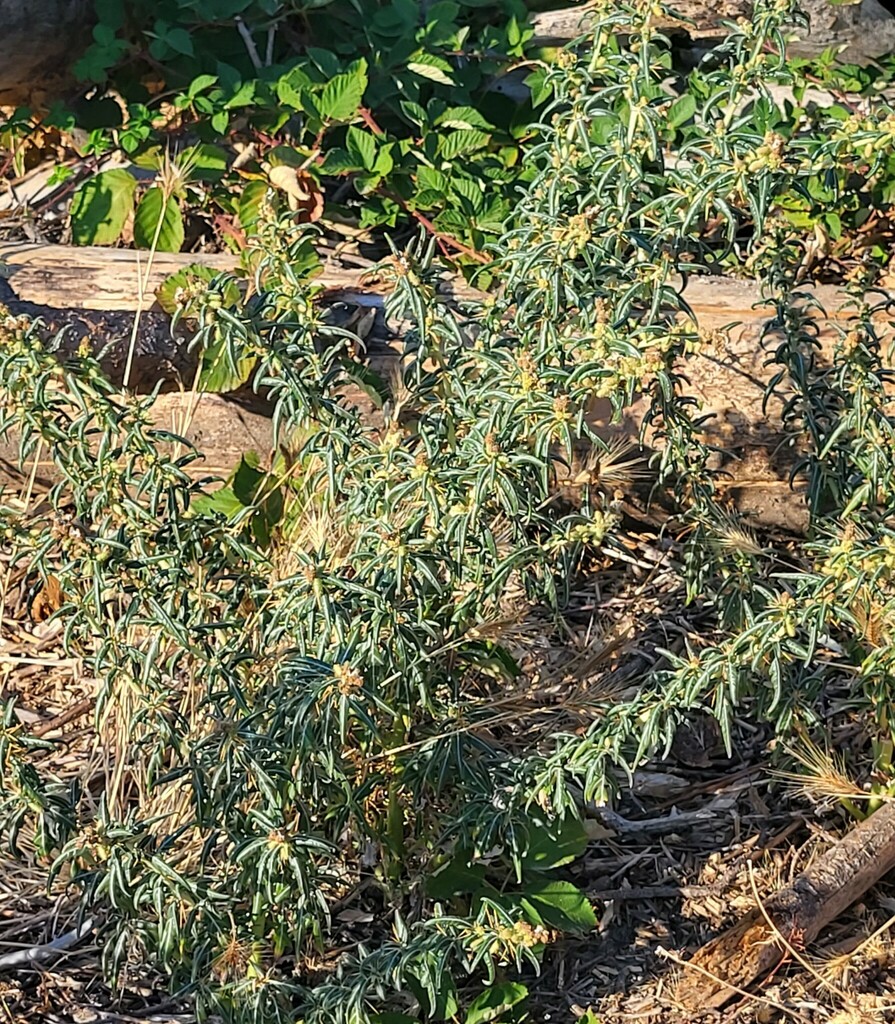
Spiny cocklebur grows up to 3 feet tall. Its stem is yellow to brown, tough, hairy, and branched.
ton_bal, inaturalist.org
Burs are smooth and covered in spines with hooked ends. There are two seeds in each burr, each flat, 3/8 inch long, and brown.
3. Infestation Basics
“Spiny cocklebur is a serious weed of numerous crops, capable of causing severe yield losses. The seeds and seedlings contain hydroquinone, which is toxic to livestock.”
– J. Neudorf et.al., 2023
Where does it grow, and how does it spread?
Spiny cocklebur has adapted to grow in several different environments. It typically invades disturbed areas but can also spread via human or animal movement and water. Seeds can stay dormant for up to 8 years. [1,4]
This weed has adapted to grow in a wide range of soil types under varying moisture and temperature conditions. It has a slight preference for moist soils, so it establishes itself more frequently near bodies of water and floodplains, but can be found in several areas. The only places it does not appear to grow are areas with extreme temperatures, such as very cold tundra conditions, very hot and dry deserts, or lowland tropical climates. Most disturbed areas are at risk of invasion. [3,4]
Spiny cocklebur is an herbaceous annual that grows in any disturbed area. It can germinate any time between early spring and summer after rain. Each plant produces an average of 150 seeds, with 2 seeds in each burr. Emergence can occur between spring and fall. Burs form 2-3 months after emergence. Most plants die in late fall or early winter due to frost. [4]
Seeds are usually spread by burs that hook onto livestock fur, but they can also cling to human clothing. These burs float and can remain in water for extended periods. Burs and seeds have also been found in hay bales, mud on equipment and shoes, and contaminated seeds or grain. Once the seed has germinated, it grows rapidly and releases allelopathic compounds that inhibit the germination and growth of nearby crops. [4]
Key takeaway: Spiny cocklebur can invade multiple habitats but shows a slight preference for moist environments. It reproduces only by seed, which is readily dispersed to disturbed areas.
Why is it so invasive?
Spiny cocklebur can adapt to grow in several different environments. Although it reproduces only by seed, it can produce 150 seeds per plant, which spread readily via human or animal movement, and is allelopathic, inhibiting the growth of nearby plants. It is poisonous when young and sometimes when mature. [1,4]
This weed is spread by its seeds, which have a very high germination rate. Seeds are usually spread by livestock, as these plants’ burs cling to fur. It can also spread via water and humans, as the burs adhere to clothing and muddy equipment and can remain afloat for extended periods. [2,4]
Spiny cocklebur is allelopathic, meaning it inhibits the growth and germination of other plants. It particularly affects summer crops such as wheat, tomatoes, and corn. Additionally, this plant is poisonous, especially to horses and pigs. Seeds contain carboxyatractyloside and hydroquinone, poisonous compounds. As the plant matures, it loses some of its toxicity, but it can still be dangerous, especially when burs begin to develop. Symptoms of poisoning include depression, nausea, anorexia, and death can occur a few hours to 3 days after ingestion. [1,3,4]
Key takeaway: This plant can establish itself in any disturbed area. Seeds and seedlings are highly toxic and readily spread. It threatens native species and agriculture with its toxins and allelopathic tendencies.
Common risk factors for invasion
- Soil disturbance: Spiny cocklebur readily invades disturbed soils, including construction sites, tilled fields, and overgrazed pastures. This disruption weakens existing vegetation, thereby facilitating the weed’s establishment. Minimizing unnecessary soil disturbance can help reduce the risk of invasion.
- Human activity: Spiny cocklebur thrives in disturbed soils, including construction sites, agricultural fields, roadsides, and other areas where natural vegetation has been disrupted. These disturbances create openings in the soil that enable the plant to establish itself. Additionally, the movement of soil, agricultural products, and equipment can inadvertently introduce weeds to new areas.
- Moisture availability: While spiny cocklebur has adapted to survive across all soil and water conditions, it generally requires some moisture to establish and spread, making irrigated lands and areas with consistent rainfall particularly vulnerable.
- Riparian Areas: Seeds are readily transported by streams and may subsequently be deposited on river terraces. Spiny cockleburs prefer areas with moisture, so they are more likely to invade these areas.
Impacts
Economic
This weed can grow in a range of environmental conditions. It establishes itself in cultivated fields and competes with agricultural crops, resulting in yield losses of up to 70%. It becomes entangled in sheep wool, thereby increasing production costs. [4]
Ecosystem Health
Once established, spiny cocklebur displaces native plants, resulting in a notable loss of floral and faunal biodiversity. [2,4]
Erosion
Spiny cocklebur significantly increases the risk of soil erosion by outcompeting and displacing native bunchgrasses and ground cover. These native plants play a crucial role in stabilizing soil through extensive root systems that bind the soil and reduce runoff. When spiny cocklebur takes over, it replaces these stabilizing plants with its shallow, less effective root structure, leaving the soil more vulnerable to water erosion. [4]
Health and Safety
Spiny cocklebur can physically injure children, workers, livestock, and wildlife with its spikes. However, humans and animals tend to avoid this plant, and there have been no reports of serious injuries from its spikes. Its spikes are a nuisance to workers hand-picking crops. This plant is poisonous when ingested, especially when young. [1,3]
Agriculture and Food Security
Farmers and ranchers face increased costs associated with managing this weed. It is considered allelopathic, particularly for summer crops such as corn, where it inhibits plant growth and germination. Furthermore, spiny cocklebur can harbor pests and diseases that may affect crops, exacerbating the threat to food production. The economic burden on farmers and the potential for decreased food supply contribute to the overall negative impact on food security in the region. [1,4]
Livestock
Spiny cocklebur is poisonous to all animals, especially horses and pigs. Although grazing animals tend to avoid it because of its spikes, it is most toxic in its early stages of life, before spikes appear. Burs attach to animal fur and can spread to new areas. Additionally, animals will avoid this plant and graze the surrounding area, leaving space for new plants to establish. [3,4]
4. Management Strategies
Prevention is the most effective and easiest way to manage this weed. Avoid unnecessary disturbance of areas and maintain vegetation health. Clean equipment and shear woolly animals before moving to a new area to prevent seed dispersal. If an infestation occurs, mechanical methods are effective when applied before burrs develop. Seeds can remain dormant for several years, so it is important to continue mowing or removing plants for at least 3 years. Do not leave plants with immature burs on site, as they can still develop viable seeds. Some herbicides are effective, especially when combined with mechanical control methods. [1,7]
DO’s
- Remove spiny cocklebur before burs develop to prevent seed production and stop the spread.
- Maintain healthy vegetation and avoid unnecessary soil disturbance.
- Continue to monitor for reemergence for at least 3 years after the infestation.
DON’Ts
- Leave plants with immature burs on site, as seeds can still develop.
- Leave it until it becomes a widespread problem, as it is easier to manage individual or small infestations.
- Allow animals to graze infected areas, as spiny cocklebur is poisonous.
** The following information is provided courtesy of the UC Weed Research and Information Center. nmweeds.org does not endorse the use of any particular product, brand, or application thereof. **
Non‑chemical management of spiny cocklebur focuses on preventing seed production through consistent hand‑pulling or cutting plants before the burs mature. Repeated disturbance, mowing at early growth stages, and maintaining dense, competitive vegetation help reduce establishment over time.
Mechanical (pulling, cutting, disking) |
Hand pulling is effective on small incipient populations. Pulling is most effective before bur development and seed dispersal. Mowing or disking at the flowering stage will control cockleburs. Resprouts may occur after mowing, and a secondary treatment may be required. Cut-off plants with immature burs can still develop viable seed. |
Neither grazing nor burning is considered an effective control option.
In the western U.S., there are no efforts to use biological control agents.
The following specific use information is based on published papers and reports by researchers and land managers. Other trade names may be available, and other compounds also are labeled for this weed. Directions for use may vary between brands; see label before use. Herbicides are listed by mode of action and then alphabetically. The order of herbicide listing is not reflective of the order of efficacy or preference.
|
2,4-D Several names |
Rate: Broadcast treatment: 2 to 4 pt product/acre (0.95 to 1.9 lb a.e./acre). Timing: Postemergence when plants are growing rapidly. Applications in spring provide best control. Remarks: 2,4-D is selective for broadleaf species and will not damage desirable grasses growing nearby. Good coverage is necessary. 2,4-D can be tank-mixed with dicamba, and is available in apremix with triclopyr (Crossbow). |
|
Aminopyralid Milestone |
Rate: Broadcast treatment: 3 to 5 oz product/acre (0.75 to 1.25 oz a.e./acre) plus 0.25 to 0.5% v/v surfactant. Timing: Early postemergence when plants are small and rapidly growing. Remarks: Aminopyralid is a selective herbicide for broadleaf species and will not damage desirable grasses growing nearby. Other options include aminopyralid in a premix with 2,4-D (Forefront HL, 1.5 to 2.1 pt product/acre) or metsulfuron (Opensight, 1.5 to 2 oz product/acre). The formulation with metsulfuron is not registered for use in California. |
|
Clopyralid Transline |
Rate: Broadcast treatment: 4 to 10 oz product/acre (1.5 to 3.75 oz a.e./acre) plus 0.25 to 0.5% v/v surfactant, applied to thoroughly wet all leaves. Timing: Early postemergence when plants are small and rapidly growing. Remarks: Clopyralid is a selective herbicide for broadleaf species and will not damage desirable grasses growing nearby. Clopyralid can be tank mixed with triclopyr (Garlon 4 Ultra) for control of cockleburs. |
|
Dicamba Banvel, Clarity |
Rate: Broadcast treatment: 0.5 to 1.5 pt product/acre (0.25 to 0.75 lb a.e./acre) plus 0.25 to 0.5% v/v surfactant. Timing: Early postemergence when plants are small and rapidly growing. Remarks: Dicamba is a selective herbicide for broadleaf species and will not damage desirable grasses growing nearby. Dicamba can be tank mixed with 2,4-D. Overdrive, a premix of dicamba with diflufenzopyr, has been reported to be effective on common cocklebur. Diflufenzopyr is an auxin transport inhibitor which causes dicamba to accumulate in shoot and root meristems, increasing its activity. Overdrive is applied postemergence at 4 to 8 oz product/acre. Higher rates should be used on large annuals. Add non-ionic surfactant to the treatment solution at 0.25% v/v, or methylated seed oil at 1% v/v solution.
|
|
Fluroxypyr Vista XRT
|
Rate: Broadcast treatment: 11 oz product/acre (3.4 oz a.e./acre) plus 0.25 to 0.5% v/v surfactant. To optimize control use 0.25 to 0.5% v/v seed oil surfactant. Timing: Postemergence, when plants are growing rapidly. Remarks: Fluroxypyr is a selective herbicide for broadleaf species and will not damage desirable grasses growing nearby. |
|
Picloram Tordon 22K
|
Rate: Broadcast treatment: 1 to 2 pt product/acre (4 to 8 oz a.e./acre) plus 0.25 to 0.5% v/v surfactant. Timing: Postemergence, when plants are growing rapidly. Remarks: High levels of picloram can give long-term soil activity for broadleaves. Also available in premixes with 2,4-D (Grazon P+D) or fluroxypyr (Surmount). Picloram is a restricted use herbicide. Picloram and all formulations including picloram are not registered for use in California. |
|
Triclopyr Garlon 4 Ultra, Remedy Ultra
|
Rate: 2 pt product/acre (1 lb a.e./acre) Timing: Early postemergence, when plants are small and rapidly growing. Remarks: Triclopyr is a selective herbicide for broadleaf species and will not damage desirable grasses growing nearby. Remedy Ultra is the formulation used in rangelands. |
|
Glyphosate Roundup, Accord XRT II, and others |
Rate: Broadcast treatment: 1 to 2 qt product (Roundup ProMax)/acre (1.1 to 2.25 lb a.e./acre). Spot treatment: 1.5 to 2% v/v solution Roundup (or other trade name) and water. Timing: Postemergence when plants are growing rapidly. Applications in early spring provide best control. Remarks: Glyphosate is a nonselective systemic herbicide. |
|
Imazapic Plateau
|
Rate: Broadcast treatment: 4 to 6 oz product/acre (1 to 1.5 oz a.i./acre) plus 0.25 to 0.5% v/v surfactant. Timing: Preemergence or early postemergence. Remarks: Imazapic is a selective postemergence herbicide effective for controlling broadleaf weeds and some grasses. It is not registered for use in California. |
|
Imazapyr Arsenal, Habitat, Stalker, Chopper, Polaris |
Rate: Broadcast treatment: 3 to 4 pt product/acre (0.75 to 1 lb a.e./acre) plus 0.25 to 0.5% v/v surfactant. Timing: Preemergence or postemergence. Remarks: Imazapyr is effective for controlling several broadleaf and grass weeds. It is not very selective and may produce bare ground at rates above 1 pt product/acre. |
|
Metsulfuron Escort
|
Rate: Broadcast treatment: 0.33 to 0.5 oz product/acre (0.2 to 0.3 oz a.i./acre) plus 0.25 to 0.5% v/v surfactant. Timing: Early postemergence. Remarks: Metsulfuron is a selective herbicide for broadleaf species and will not damage desirable grasses growing nearby. Metsulfuron is also available in a premix with 2,4-D + dicamba (Cimarron Max). Metsulfuron and its formulations are not registered for use in California. |
|
Propoxycarbazone- sodium Canter R+P
|
Rate: 0.9 to 1.2 oz product/acre (0.63 to 0.84 oz a.i./acre) Timing: Postemergence, to small, rapidly growing plants. Remarks: Propoxycarbazone is a broad-spectrum herbicide that will control many species. It will provide only partial control of common cocklebur. Perennial grass species vary in tolerance. A non- ionic surfactant should be added at 0.25 to 0.5% v/v solution. |
|
Sulfosulfuron Outrider
|
Rate: Broadcast treatment: 0.75 to 1.33 oz product/acre (0.56 to 1 oz a.i./acre) plus 0.25 to 0.5% v/v surfactant. Timing: Preemergence or postemergence. Remarks: Sulfosulfuron is a selective, systemic herbicide for many annual and perennial weeds. |
6. References
Citations
[1] “Spiny Cocklebur Xanthium spinosum,” Washington State Noxious Weed Control Board, 2025. Available: https://www.nwcb.wa.gov/weeds/spiny-cocklebur. Accessed: Jul. 30, 2025
[2] Oregon Department of Agriculture, “Spiny cocklebur profile,” Oregon Department of Agriculture, 2015.
[3] “Xanthium spinosum Spiny cocklebur,” Texas Invasives, 2024. Available: https://texasinvasives.org/plant_database/detail.php?symbol=XASP2. Accessed: Jul. 30, 2025
[4] N. Pasiecznik, “Xanthium spinosum (bathurst burr),” CABI Compendium, Jan. 2022, doi: https://doi.org/10.1079/cabicompendium.56863
[5] J. Neudorf, A. Salzl, R. Wang, K. Castro, K. Entwistle, and Canadian Food Inspection Agency, “Fact Sheets Xanthium spinosum L.,” International Seed Morphology Association, 2023. Available: https://seedidguide.idseed.org/fact_sheets/xanthium-spinosum/
[6] M. Romero et al., “Optimization of xanthatin extraction from Xanthium spinosum L. and its cytotoxic, anti-angiogenesis and antiviral properties,” European Journal of Medicinal Chemistry, 2014, Available: https://pmc.ncbi.nlm.nih.gov/articles/PMC7115430/pdf/main.pdf
[7] L. Beck and J. Wanstall, “Noxious and Troublesome Weeds of New Mexico,” Nmsu.edu, 2020. Available: https://pubs.nmsu.edu/_circulars/CR698/#a66. Accessed: Jul. 30, 2025
Diane Rose, inaturalist.org
Leandro Bareiro, inaturalist.org
Fun Facts
Spiny cocklebur was traditionally used medicinally as a diuretic. Currently, there are several studies on how this plant can be used to make drug compounds, and it is commonly used in Argentina to treat several ailments. [4,6]
ton_bal, inaturalist.org
Sunny Saroa, inaturalist.org
Fun Facts
Xanthium derives from a Greek word meaning “yellow,” as yellow dye can be extracted from some related species. Spinosum is a Latin term meaning “spiny,” referring to the plant’s spiny texture. [4]
ton_bal, inaturalist.org
Diane Rose, inaturalist.org
Fun Facts
Spiny cocklebur has not been studied as extensively as common cocklebur, the only other species in the genus Xanthium. More research on X. spinosum specifically is necessary to better understand management methods and the plant’s effects. [4,6]
Aleksandr Ebel, inaturalist.org
John M. Randall, The Nature Conservancy, Bugwood.org
John M. Randall, The Nature Conservancy, Bugwood.org
Barry Rice, sarracenia.com, Bugwood.org
Spyridon Oikonomidis, Inaturalist.org